Course · Geometry
1.1 Points, Lines and Planes
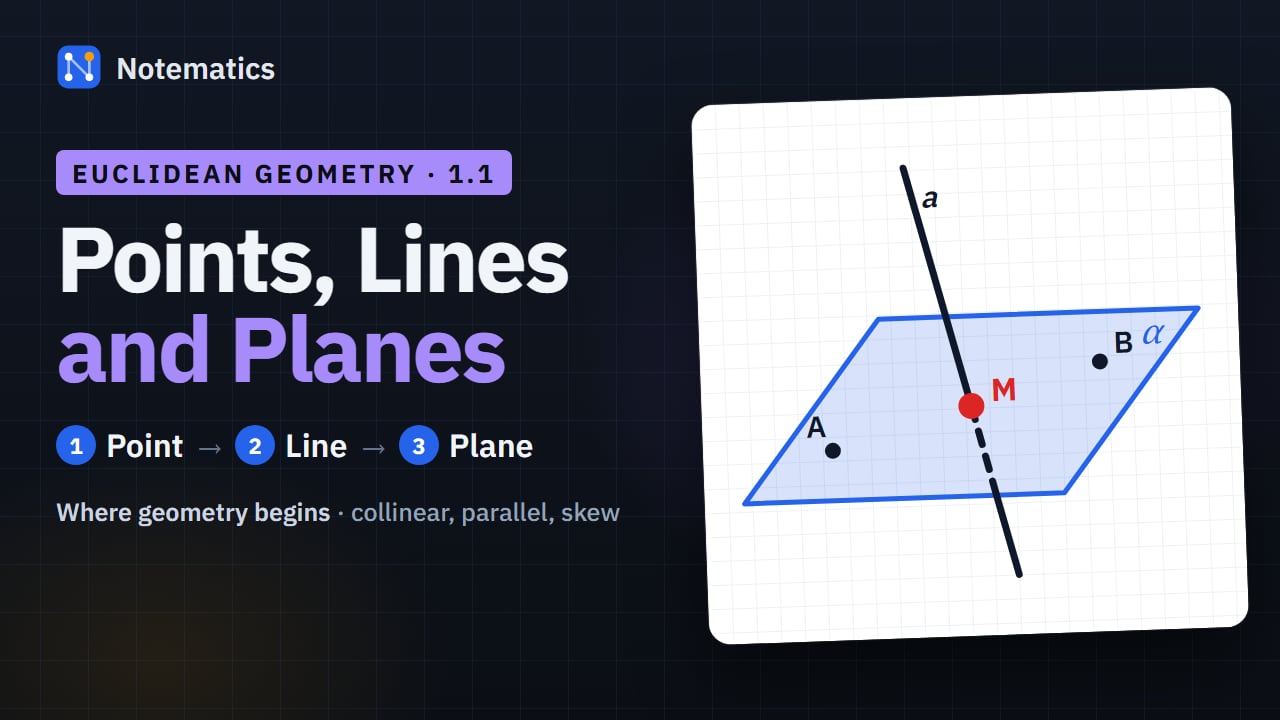
The first lesson of a full course of Euclidean geometry. Point, line and plane are the three undefined terms: everything else in geometry is built from them. See how they are drawn and named, what collinear and coplanar mean, and how two lines can lie: intersecting, parallel or skew. Then one worked example on a cuboid and four practice questions with answers.
What the lesson covers
The undefined terms and their names; collinear, coplanar; intersecting, parallel, skew lines; a line and a plane, two planes.
- 8 pages
- 38 steps
- video 5:48
Watch
The board is kept in this browser only, like your other boards, and is yours to change. Each press makes a new board.
What to remember
- A point has no size. A line and a plane have no thickness and no end.
- Through two points there is exactly one line.
- Points on one line are collinear; points in one plane are coplanar.
- Two lines in a plane intersect at one point or are parallel. In space they can also be skew.
- A line crosses a plane at one point. Two planes meet in a line.
Pages and steps
- Point, line, plane
- Three ideas
- Point
- Line
- Plane
- Undefined terms
- Points and lines
- Line a
- Points on the line
- A point off the line
- One line through two points
- Collinear
- Not collinear
- Two lines
- Two lines
- Intersecting
- Parallel
- Skew
- In a plane
- Points, lines and planes
- Planes
- Coplanar points
- A line and a plane
- Two planes
- Dashed lines
- Example
- Task
- Cuboid
- The edge AB
- Parallel
- Intersecting
- Skew
- Answer
- Remember
- Remember
- One line
- Collinear, coplanar
- Two lines
- Two planes
- Practice
- Four tasks
- Answers
- Answer 1
- Answer 2
- Answer 3
- Answer 4