Course · Geometry
10.2 Constructing Bisectors
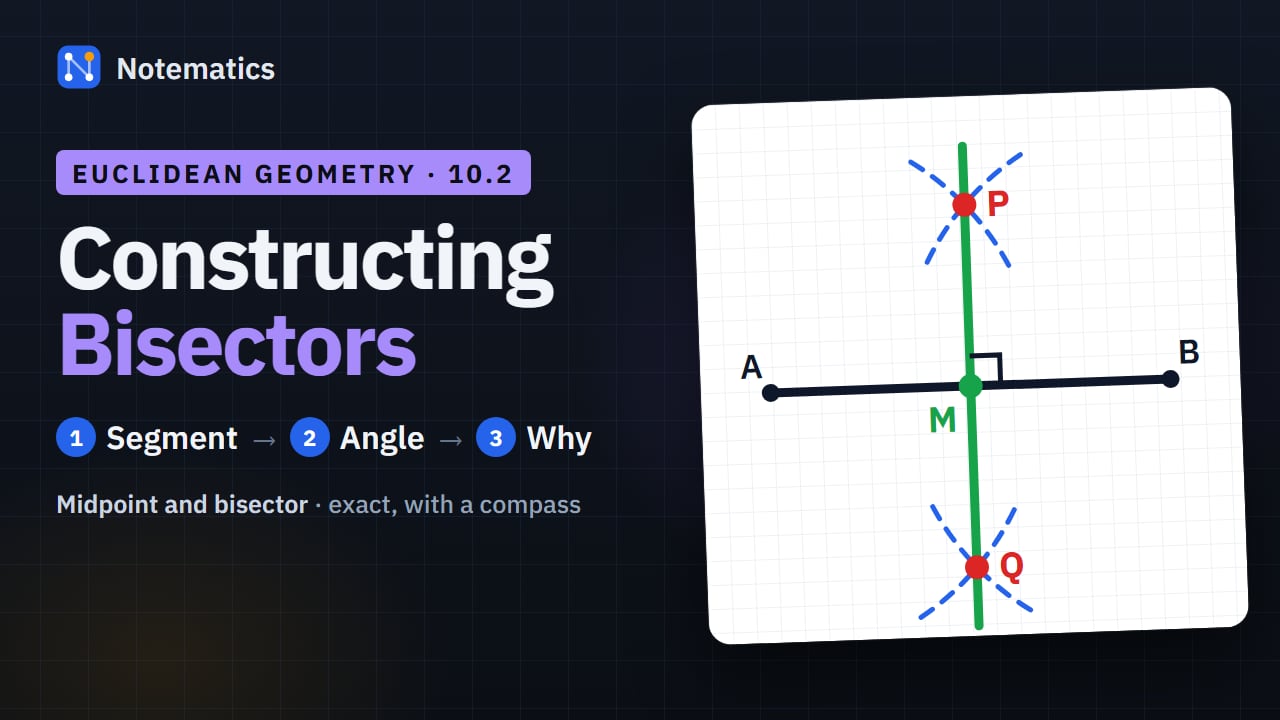
Two constructions every geometry student needs, done move by move with compass and straightedge: the perpendicular bisector of a segment, which also gives its midpoint, and the bisector of an angle. After each construction, the reason it is exact: four equal compass openings make a rhombus, and three pairs of equal sides make two congruent triangles. Then four constructions to do yourself on paper, with the finished drawings at the end.
What the lesson covers
The perpendicular bisector of a segment (and the midpoint); the bisector of an angle; why both work.
- 8 pages
- 36 steps
- video 6:01
Watch
The board is kept in this browser only, like your other boards, and is yours to change. Each press makes a new board.
What to remember
- Perpendicular bisector: equal arcs from both ends of the segment, above and below. Join the two crossings.
- It gives the midpoint and a right angle at once.
- Angle bisector: an arc from the vertex, then equal arcs from the two points it marks. Join the vertex to the crossing.
- Why they work: equal openings make a rhombus, or two triangles congruent by SSS.
- Every point of the perpendicular bisector is equally far from the two ends of the segment.
Pages and steps
- Two bisectors
- To bisect
- Of a segment
- Of an angle
- The plan
- Construction 1: perpendicular bisector
- Given
- Move 1
- Move 2
- Move 3
- What we got
- Why it works: a rhombus
- The four points
- Four equal sides
- A rhombus
- Its diagonals
- So
- One more property
- Construction 2: bisector of an angle
- Given
- Move 1
- Move 2
- Move 3
- Move 4
- Why it works: two triangles
- Two triangles
- First pair
- Second pair
- Third pair
- Congruent
- Equal angles
- Remember
- Remember
- Two for one
- Angle bisector
- Why
- Equally far
- Practice
- Four tasks
- Answers
- Answer 1
- Answer 2
- Answer 3
- Answer 4