Course · Geometry
11.7 Geometric Inequalities
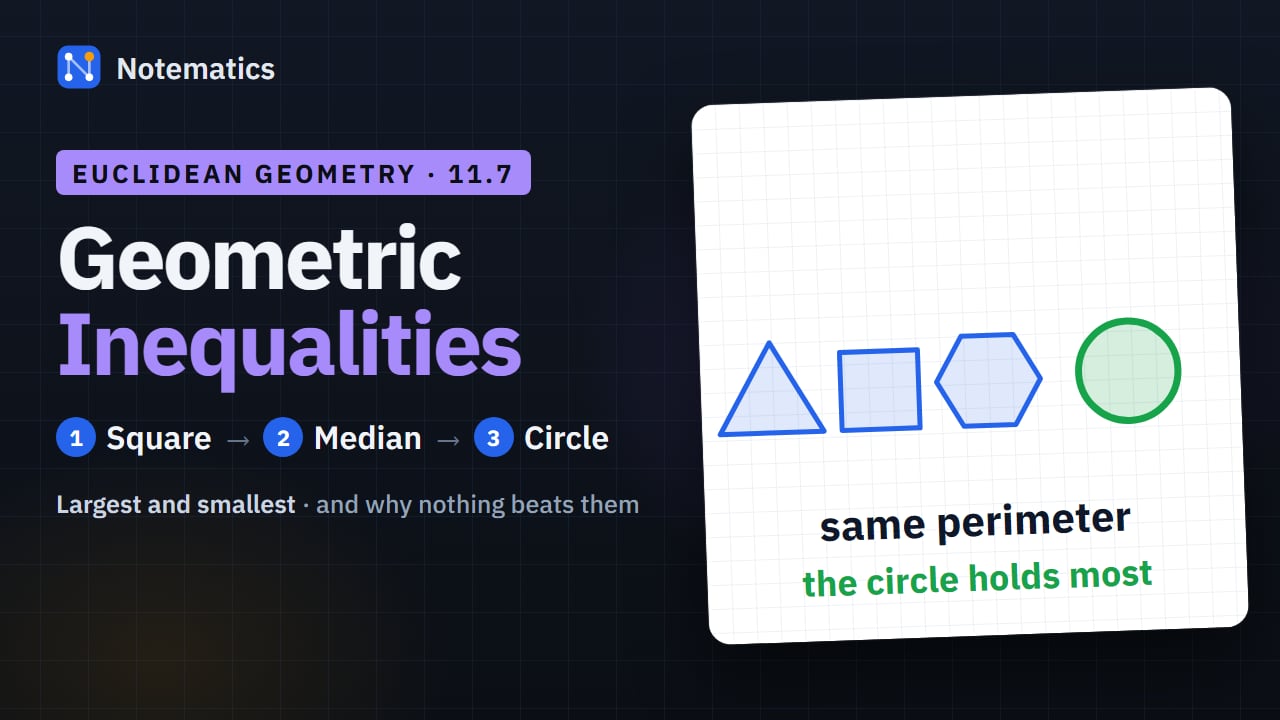
The last lesson of the course: geometry that compares. Which rectangle with a given perimeter has the greatest area, and why is it the square? Why is a median always shorter than half the sum of two sides? Why is the circumcircle of a triangle at least twice as large as its incircle (Euler's inequality, R ≥ 2r)? And which of all shapes with the same perimeter holds the most: the isoperimetric idea. One picture and one idea for each. Then a worked example (a fence along a wall) and four practice questions with answers.
What the lesson covers
Largest and smallest: the rectangle of greatest area; a median is shorter than half the sum of two sides; R ≥ 2r; the isoperimetric idea.
- 9 pages
- 40 steps
- video 6:53
The board is kept in this browser only, like your other boards, and is yours to change. Each press makes a new board.
What to remember
- With a given perimeter, the square is the rectangle of the greatest area. Two numbers with a given sum have the greatest product when they are equal.
- A median is shorter than half the sum of the two sides beside it: m < (b + c)/2.
- In every triangle R ≥ 2r, with equality only in the equilateral triangle.
- Of all shapes with the same perimeter, the circle has the greatest area.
Pages and steps
- Largest and smallest
- Long and thin
- In between
- The square
- Inequalities
- The square wins
- A square
- A rectangle
- Lost
- Gained
- Compare
- The inequality
- A median and two sides
- Triangle
- The median
- Double it
- A parallelogram
- A triangle
- The inequality
- Euler's inequality
- The incircle
- The nine-point circle
- Push the sides out
- Compare
- The inequality
- Same perimeter, greatest area
- Triangle
- Square
- Hexagon
- Circle
- The circle wins
- Example
- Wall and pen
- Name the sides
- The area
- The idea
- Answer
- Remember
- Remember
- The median
- Euler
- The circle
- Practice
- Four tasks
- Answers
- Answer 1
- Answer 2
- Answer 3
- Answer 4