Course · Geometry
3.1 Properties of Parallel Lines
What makes lines parallel, and what follows from it? This lesson starts the chapter on parallel and perpendicular lines. Through a point off a line there is exactly one parallel: from this single fact we get three useful properties, each with a short reason why. Then a worked example (three right angles force the fourth) and four practice questions with answers.
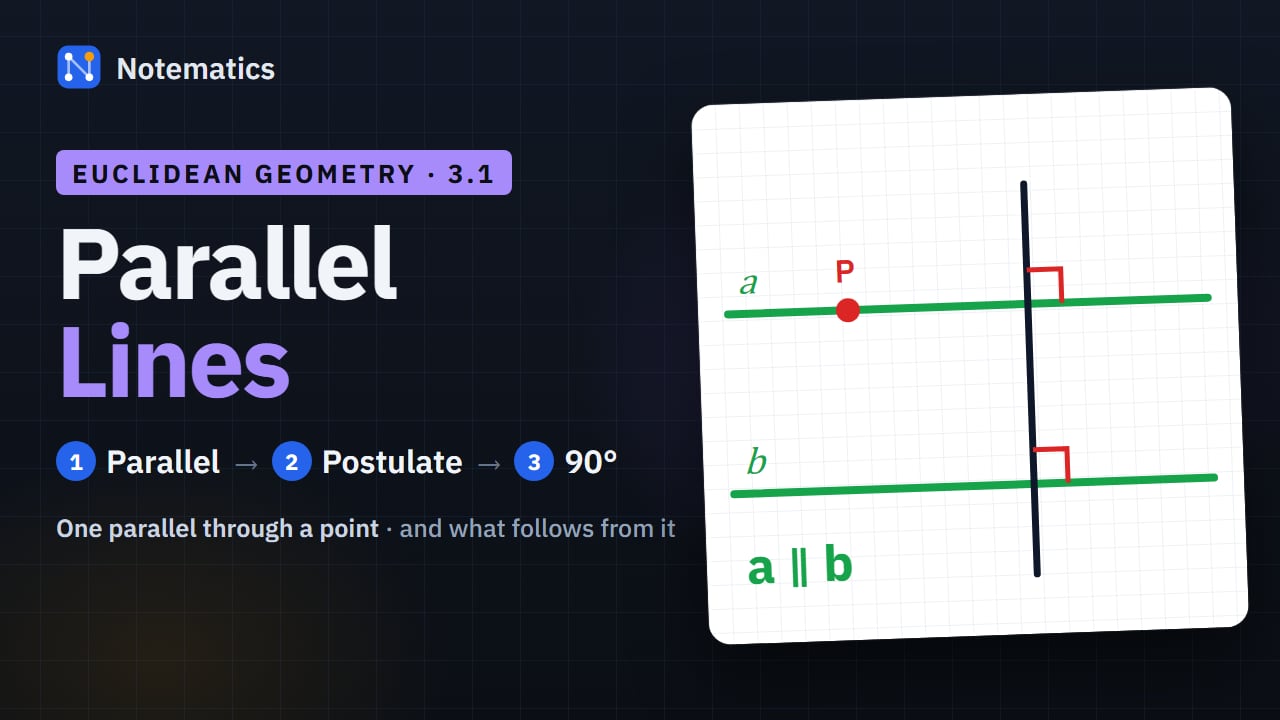
What the lesson covers
Parallel and perpendicular lines; one parallel through a point; a ∥ b and b ∥ c give a ∥ c; two lines perpendicular to a third are parallel; a perpendicular to one of two parallels is perpendicular to the other.
- 9 pages
- 42 steps
- video 6:53
Watch
The board is kept in this browser only, like your other boards, and is yours to change. Each press makes a new board.
What to remember
- Parallel lines lie in one plane and never meet. Perpendicular lines cross at a right angle.
- Through a point not on a line there is exactly one parallel to the line.
- Two lines parallel to a third line are parallel to each other.
- In a plane, two lines perpendicular to the same line are parallel.
- A line perpendicular to one of two parallel lines is perpendicular to the other.
Pages and steps
- Parallel and perpendicular
- Two special pairs
- Parallel
- Perpendicular
- Segments and rays
- One parallel through a point
- Line a
- A point off the line
- A line through P
- Another line
- The parallel
- Exactly one
- Parallel to the same line
- Three lines
- Suppose the opposite
- Two parallels through M
- Impossible
- Proved
- Two perpendiculars to one line
- Line c
- First perpendicular
- Second perpendicular
- Could they meet?
- Parallel
- A perpendicular to one of two parallels
- Two parallel lines
- A perpendicular to a
- It crosses b
- A line through B
- It is b
- The theorem
- Example
- Task
- Quadrilateral
- AB and CD
- AD and BC
- The angle D
- Answer
- Remember
- Remember
- One parallel
- Parallel to a third
- Two perpendiculars
- One perpendicular
- Practice
- Four tasks
- Answers
- Answer 1
- Answer 2
- Answer 3
- Answer 4