Course · Geometry
3.4 Distance from a Point to a Line
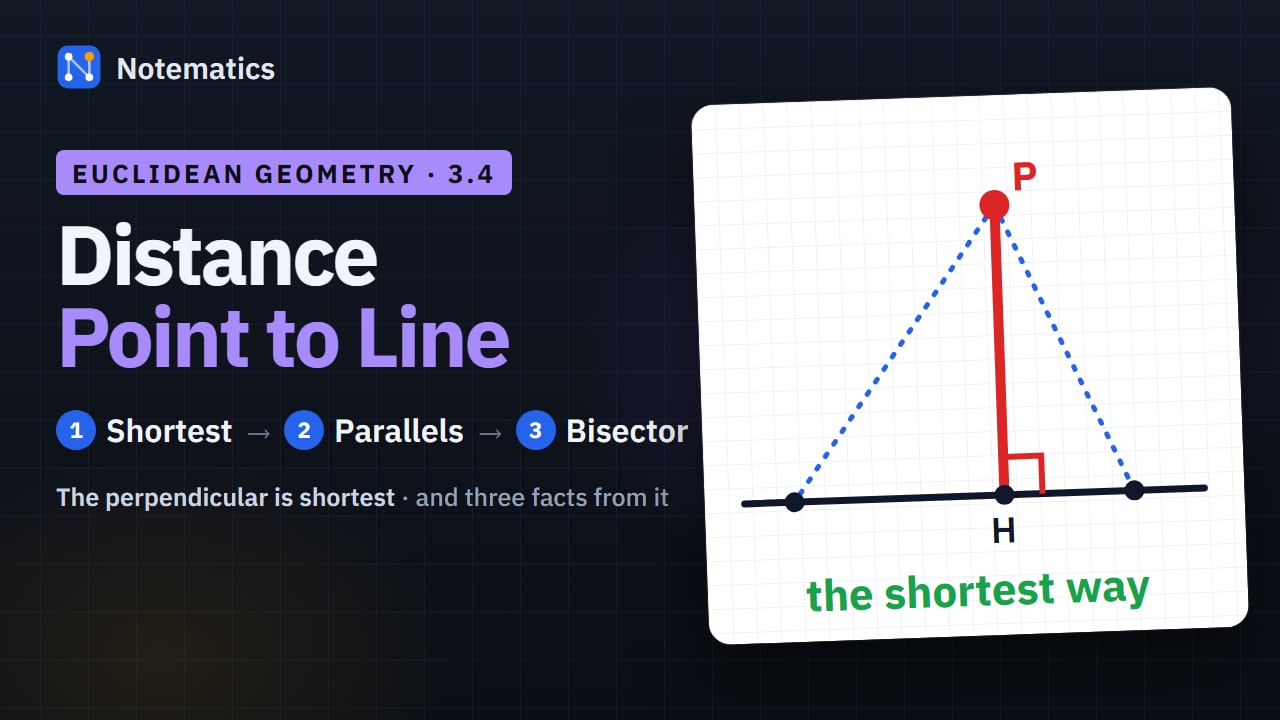
How far is a point from a line? The answer is always the perpendicular, and this lesson shows why it is the shortest path. From this one idea come three more: an altitude of a triangle is a distance, two parallel lines are the same distance apart everywhere, and every point of an angle bisector is equally far from the two sides of the angle. Then a worked example solved without a single calculation, and four practice questions with answers.
What the lesson covers
The perpendicular is the shortest path; foot of the perpendicular; distance between parallel lines; altitudes as distances; points of an angle bisector are equally far from its sides.
- 8 pages
- 36 steps
- video 6:02
The board is kept in this browser only, like your other boards, and is yours to change. Each press makes a new board.
What to remember
- The distance from a point to a line is the length of the perpendicular. Its end on the line is the foot.
- The perpendicular is shorter than any other segment from the point to the line.
- The distance between two parallel lines is the same everywhere.
- An altitude of a triangle is the distance from a vertex to the line of the opposite side.
- Every point of an angle bisector is equally far from the two sides of the angle.
Pages and steps
- The shortest way to a line
- A point and a line
- One path
- Another path
- The perpendicular
- Why it is the shortest
- The shortest path
- Altitudes are distances
- Inside
- Outside
- To the line
- Between parallel lines
- Two parallel lines
- From A
- From B
- A diagonal
- Congruent triangles
- The same distance
- Points of an angle bisector
- An angle and its bisector
- A point on the bisector
- Two distances
- Two triangles
- Equal distances
- And back
- Example
- Task and triangle
- The bisector
- The distance asked for
- The other distance
- Answer
- Remember
- Remember
- Shortest
- Parallel lines
- Altitudes
- Bisector
- Practice
- Four tasks
- Answers
- Answer 1
- Answer 2
- Answer 3
- Answer 4