Course · Geometry
7.3 Slope
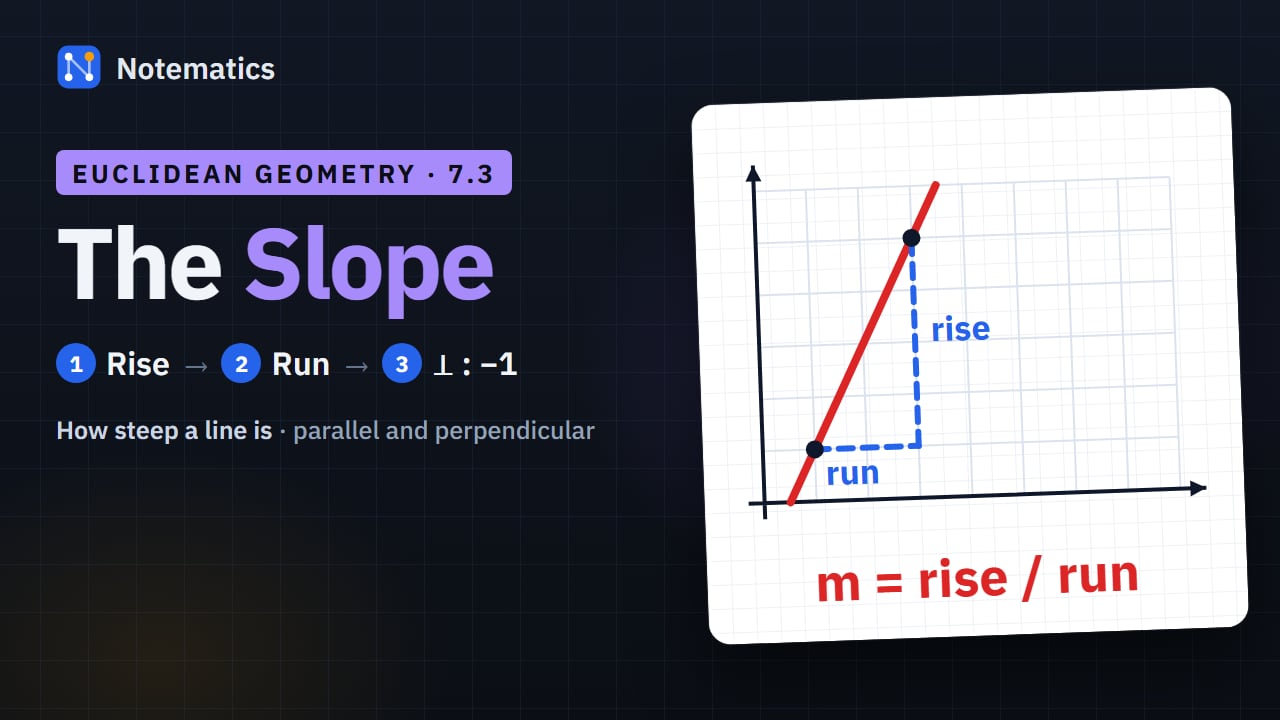
What the slope of a line is and how to find it from two points. Slope is rise over run: how far the line goes up for every step to the right. See the four kinds of slope (positive, negative, zero, undefined), why parallel lines have equal slopes, and why the slopes of perpendicular lines multiply to −1: turn the slope triangle by a quarter turn and its run and rise change places. One worked example (prove a right angle with two slopes) and four practice questions with answers.
What the lesson covers
Rise over run; positive, negative, zero, undefined; parallel lines have equal slopes; perpendicular ones multiply to −1.
- 9 pages
- 41 steps
- video 6:39
Watch
The board is kept in this browser only, like your other boards, and is yours to change. Each press makes a new board.
What to remember
- Slope is rise over run: m = (y₂ − y₁)/(x₂ − x₁).
- A rising line has a positive slope, a falling line a negative one. Horizontal: 0. Vertical: no slope.
- Parallel lines have equal slopes: m₁ = m₂.
- The slopes of perpendicular lines multiply to −1: m₁ · m₂ = −1.
Pages and steps
- How steep is a line?
- A line
- Two points
- Run
- Rise
- Slope
- What 2 means
- The slope formula
- The same line
- From the coordinates
- The formula
- Any two points
- Watch out
- Four kinds of slope
- Positive
- Negative
- Zero
- Undefined
- Zero is not no slope
- Parallel lines
- Two lines
- The slope of a
- The slope of b
- The rule
- Why
- Perpendicular lines
- The line a
- Its slope
- A quarter turn
- The slope of b
- The product
- The rule
- Example: a right angle
- The triangle
- The slope of AB
- The slope of BC
- The product
- Answer
- Remember
- Remember
- Four kinds
- Parallel
- Perpendicular
- Practice
- Four tasks
- Answers
- Answer 1
- Answer 2
- Answer 3
- Answer 4