Course · Geometry
1.4 Postulates and Axioms
Why does geometry need postulates? Every theorem is proved from earlier facts, and that chain has to start somewhere: with a few statements accepted without proof. This lesson shows Euclid's five postulates one by one, the famous fifth (the parallel postulate) in its modern form, and the difference between a postulate and a theorem. Then a first tiny proof, and four practice questions with answers.
What the lesson covers
What a postulate is and why geometry needs them; Euclid's five postulates; the parallel postulate; postulate versus theorem.
- 9 pages
- 41 steps
- video 6:26
Watch
The board is kept in this browser only, like your other boards, and is yours to change. Each press makes a new board.
What to remember
- A postulate (axiom) is accepted without proof. A theorem is proved.
- Euclid's five: draw a segment; extend it; draw a circle; all right angles are equal; the parallel postulate.
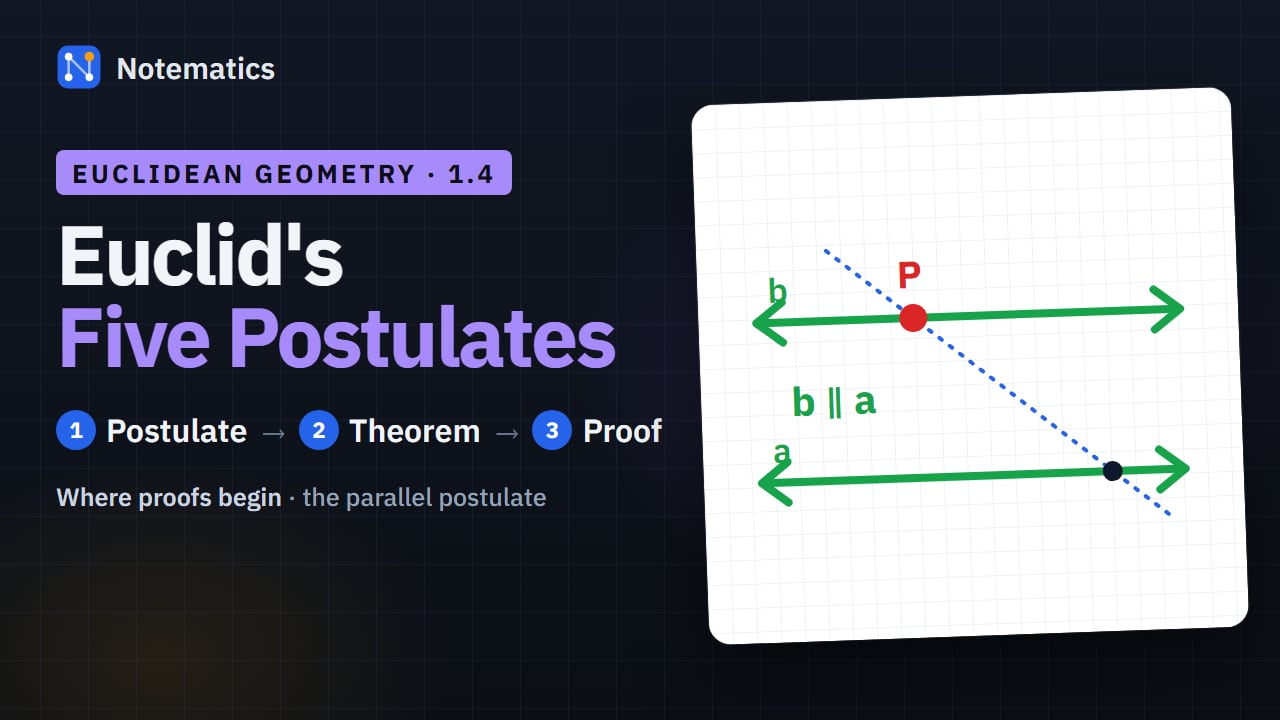
- Through a point not on a line there is exactly one line parallel to that line.
- Every proof goes back, step by step, to postulates and definitions.
Pages and steps
- Why postulates?
- A chain of reasons
- A theorem
- Why?
- The foundation
- Theorem
- Euclid
- Euclid's postulates 1, 2 and 3
- What may be drawn
- Postulate 1
- Postulate 2
- Postulate 3
- Two tools
- Postulates 4 and 5
- Two more
- Postulate 4
- Postulate 5
- They meet
- The famous one
- The parallel postulate
- A line and a point
- A parallel
- The postulate
- Any other line
- Euclidean geometry
- Postulates you already know
- Four postulates
- Two points
- Three points
- Segment addition
- Angle addition
- Example
- Task
- Line a
- Suppose
- The postulate
- Impossible
- Proved
- Remember
- Remember
- Euclid's five
- Parallel postulate
- Proofs
- Practice
- Four tasks
- Answers
- Answer 1
- Answer 2
- Answer 3
- Answer 4