Course · Geometry
1.5 Logical Reasoning and Proofs
How do we know that something in geometry is true? This lesson shows how a statement is built (if … then …, hypothesis and conclusion), why its converse is a new statement that may be false, what a counterexample is, and how a guess from examples (inductive reasoning) differs from a proof (deductive reasoning). Then two proofs written line by line: vertical angles are equal, in two columns, and a proof by contradiction. A worked example and four practice questions with answers.
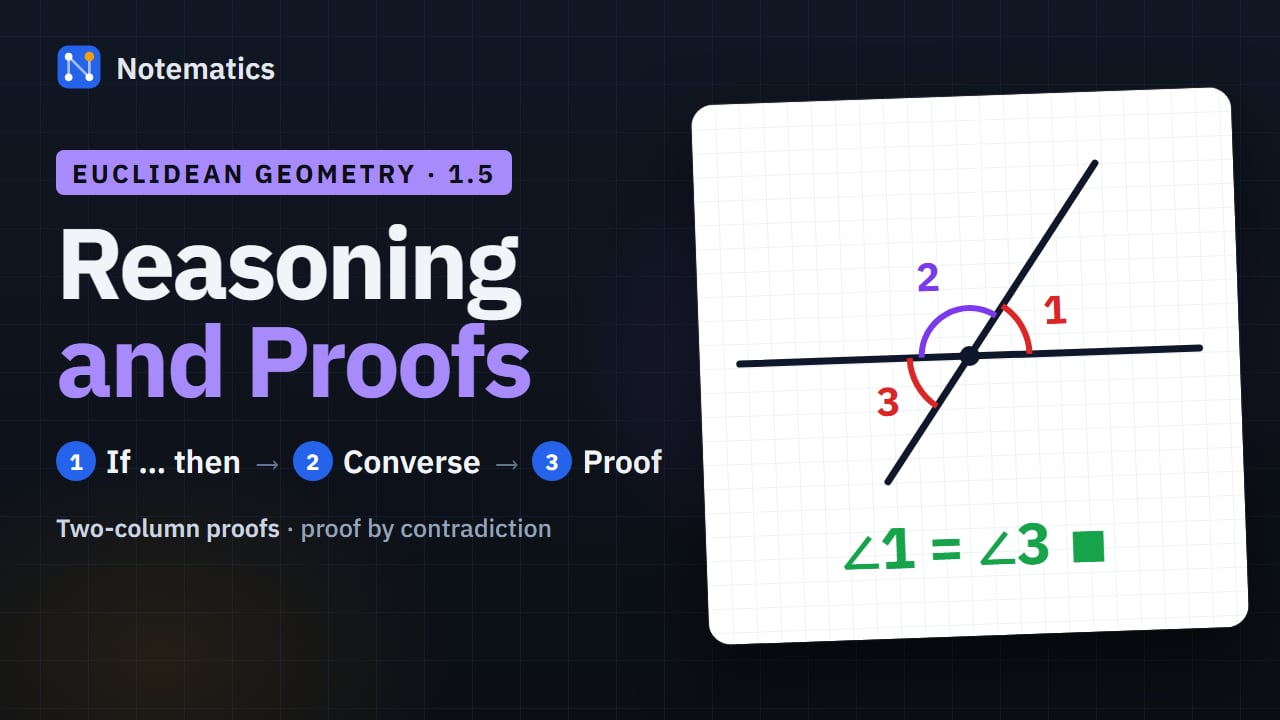
What the lesson covers
If-then statements, converse, counterexample; inductive and deductive reasoning; a two-column proof (vertical angles); proof by contradiction.
- 9 pages
- 44 steps
- video 6:51
The board is kept in this browser only, like your other boards, and is yours to change. Each press makes a new board.
What to remember
- "If p, then q": p is the hypothesis, q is the conclusion. The converse, "if q, then p", may be false.
- One counterexample shows that a statement is false.
- Examples give a conjecture. Only a proof makes it a theorem.
- In a proof every statement has a reason: given, a definition, a postulate or an earlier theorem.
- Proof by contradiction: suppose the opposite and reach the impossible.
Pages and steps
- If … then …
- Two lines
- A statement
- Hypothesis
- Conclusion
- Short form
- The converse
- Swap
- The statement
- The converse
- A counterexample
- Check the converse
- Two ways of reasoning
- Guess and proof
- Inductive
- Deductive
- Examples can mislead
- Both are needed
- A proof in two columns
- Statements and reasons
- Figure
- Given, prove
- Line 1
- Line 2
- Line 3
- Line 4
- Proof by contradiction
- The idea
- The theorem
- Suppose the opposite
- Reason on
- Contradiction
- Proved
- Example
- Task
- Figure
- Line 1
- Line 2
- Line 3
- Line 4
- Remember
- Remember
- Counterexample
- Guess and proof
- Reasons
- Contradiction
- Practice
- Four tasks
- Answers
- Answer 1
- Answer 2
- Answer 3
- Answer 4