Course · Geometry
11.1 Ceva's Theorem
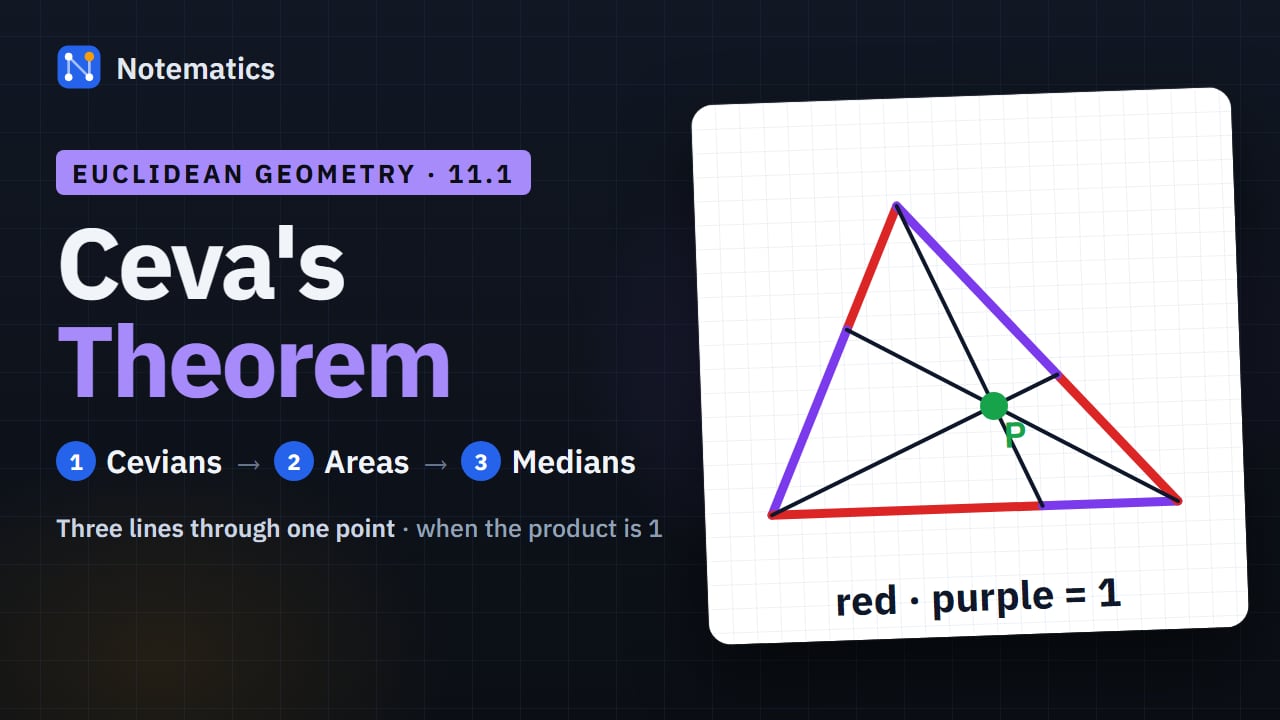
Three segments from the vertices of a triangle to the opposite sides usually miss each other. Ceva's theorem says exactly when they pass through one point: three ratios must multiply to 1. See what a cevian is, the theorem, a proof that only compares areas, the converse, and why the three medians of every triangle meet at one point. Then a worked example on the 13-14-15 triangle and three practice questions with answers.
What the lesson covers
Cevians; the theorem with a proof by areas; the converse; why the medians meet at one point.
- 9 pages
- 42 steps
- video 7:31
Watch
The board is kept in this browser only, like your other boards, and is yours to change. Each press makes a new board.
What to remember
- A cevian joins a vertex of a triangle to a point of the opposite side.
- Ceva's theorem: AD, BE, CF pass through one point exactly when (AF/FB) · (BD/DC) · (CE/EA) = 1.
- Walk round the triangle: A → F → B → D → C → E → A.
- The proof compares areas of triangles that have the same height.
- The medians pass through one point: 1 · 1 · 1 = 1.
Pages and steps
- Cevians
- Triangle
- A cevian
- Cevians we know
- Three cevians
- A small triangle
- The question
- Ceva's theorem
- Through one point
- Side AB
- Side BC
- Side CA
- The theorem
- Check
- Why it is true: areas
- One cevian
- Height from A
- Height from P
- Take away
- Three triangles around P
- Three areas
- Cevian AD
- Cevian BE
- Cevian CF
- Multiply
- Everything cancels
- The other direction: the medians
- The converse
- Three midpoints
- The product
- The medians meet
- Example
- Triangle
- Points F and D
- Two cevians
- The third cevian
- Ceva's theorem
- The numbers
- The two pieces
- Remember
- Remember
- The theorem
- The walk
- The proof
- The medians
- Practice
- Three tasks
- Answers
- Answer 1
- Answer 2
- Answer 3