Course · Geometry
11.2 Menelaus' Theorem
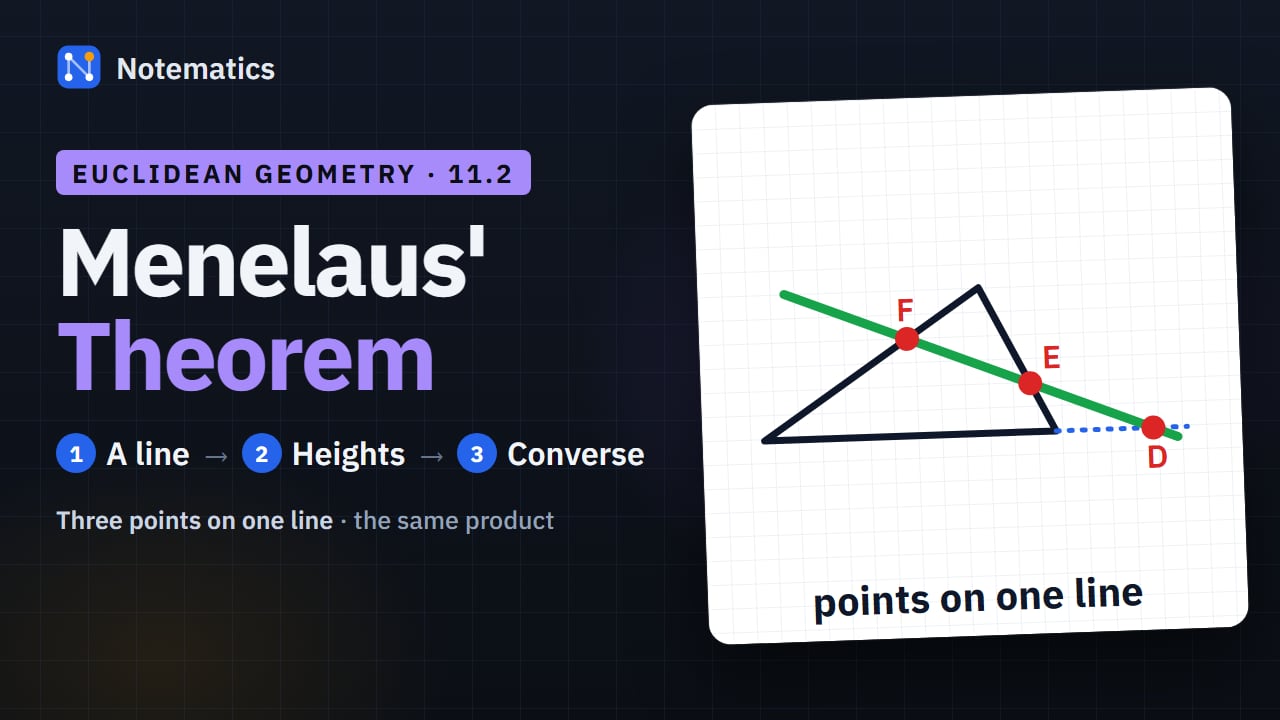
A straight line crosses a triangle. It cuts two sides and the extension of the third, and the three ratios it makes always multiply to 1. That is Menelaus' theorem, almost 2000 years old. See the theorem, a short proof with three heights and similar triangles, the converse (a way to prove that three points lie on one line), a worked example, and Ceva and Menelaus side by side. Then three practice questions with answers.
What the lesson covers
A line across a triangle; the theorem with a proof; the converse (three points on a line); Ceva and Menelaus side by side.
- 9 pages
- 41 steps
- video 7:25
Watch
The board is kept in this browser only, like your other boards, and is yours to change. Each press makes a new board.
What to remember
- A line that misses the vertices crosses two sides of a triangle and the extension of the third.
- Menelaus' theorem: if F, D, E on the lines AB, BC, CA are collinear, then (AF/FB) · (BD/DC) · (CE/EA) = 1.
- Walk round the triangle, A → F → B → D → C → E → A, also when a point is outside its side.
- The converse proves that three points lie on one line.
- Ceva: lines through one point. Menelaus: points on one line.
Pages and steps
- A line across a triangle
- Triangle
- A line
- Two sides
- The third side
- Three points on a line
- Menelaus' theorem
- The figure
- Side AB
- Side BC
- Side CA
- The theorem
- Check
- Why it is true: three heights
- The figure
- Three heights
- At F
- At D
- At E
- Multiply
- Everything cancels
- The other direction: points on a line
- The converse
- Three points
- The product
- One line
- Example
- Triangle
- Median and midpoint
- The line BM
- Choose a triangle
- Menelaus
- The numbers
- Answer
- Ceva and Menelaus
- Ceva
- Menelaus
- The difference
- Remember
- Remember
- The theorem
- The walk
- The converse
- Ceva and Menelaus
- Practice
- Three tasks
- Answers
- Answer 1
- Answer 2
- Answer 3