Course · Geometry
11.3 Stewart's Theorem
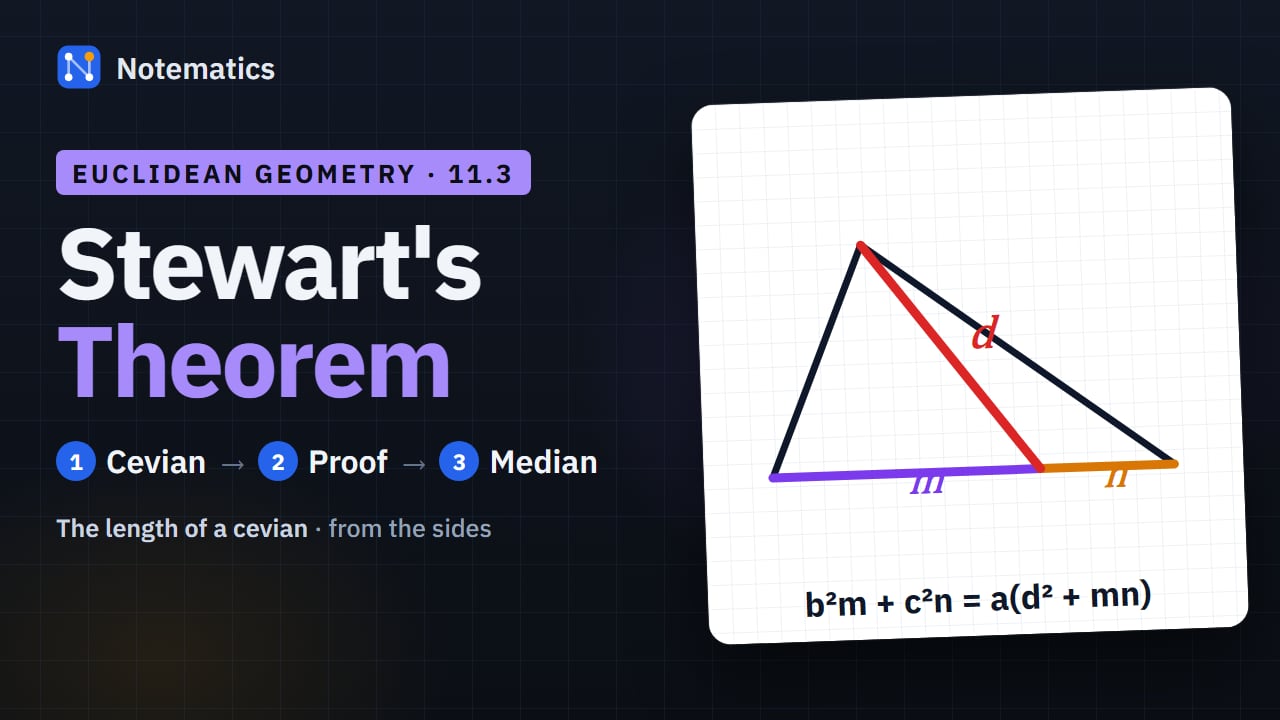
How long is a segment from a vertex of a triangle to a point of the opposite side? Stewart's theorem answers with one formula: b²m + c²n = a(d² + mn). See what the letters mean, an easy way to remember the formula (man + dad = bmb + cnc), a proof with one altitude and the Pythagorean theorem, a worked example with whole numbers, and the special case that gives the length of a median. Then three practice questions with answers.
What the lesson covers
The length of a cevian; the theorem with a proof by the Pythagorean theorem; the length of a median; an example.
- 8 pages
- 38 steps
- video 6:24
Watch
The board is kept in this browser only, like your other boards, and is yours to change. Each press makes a new board.
What to remember
- Stewart's theorem gives the length d of a cevian from the three sides and the two parts m, n of the side it cuts.
- b²m + c²n = a(d² + mn): each side goes with the part that does not touch it.
- The proof: one altitude, and the Pythagorean theorem three times.
- The median to the side a: half the square root of 2b² + 2c² − a².
Pages and steps
- How long is a cevian?
- Triangle
- The sides
- The cevian
- Two parts
- The theorem
- A way to remember
- Why it is true: one altitude
- The figure
- The altitude
- Triangle AHD
- Triangle AHB
- Triangle AHC
- Two letters too many
- Why it is true: the algebra
- Side c
- Side b
- Times n
- Times m
- Add
- Stewart's theorem
- Example
- Triangle
- The cevian
- The letters
- Stewart's theorem
- The numbers
- Simplify
- Answer
- A special case: the median
- A median
- Two equal parts
- Stewart's theorem
- The median formula
- Check
- Remember
- Remember
- The formula
- The proof
- The median
- Practice
- Three tasks
- Answers
- Answer 1
- Answer 2
- Answer 3