Course · Geometry
5.1 Parallelograms
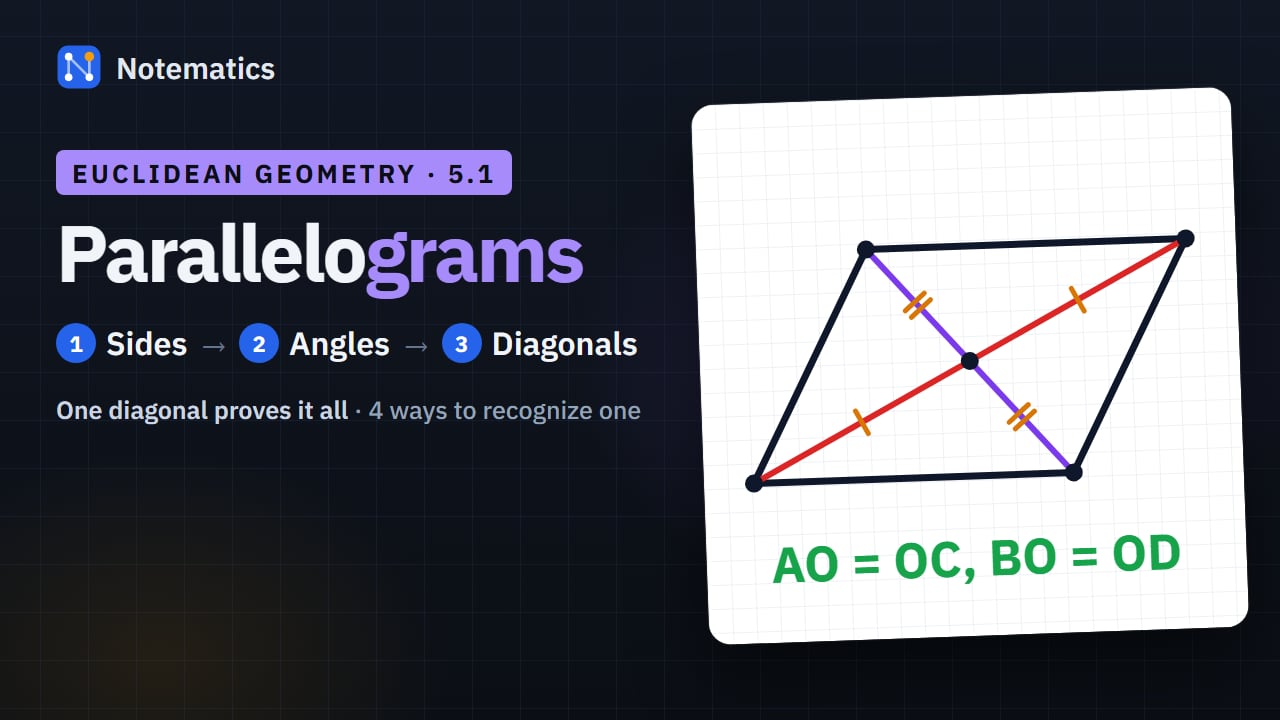
What is a parallelogram, and what follows from its parallel sides? One diagonal cuts it into two congruent triangles, and that proves everything: opposite sides are equal, opposite angles are equal, neighbor angles add to 180°, and the diagonals bisect each other. Then four tests to recognize a parallelogram, a worked example and four practice questions with answers.
What the lesson covers
Definition; opposite sides and angles equal, neighbors add to 180°, diagonals bisect each other; how to recognize a parallelogram.
- 8 pages
- 39 steps
- video 6:07
Watch
The board is kept in this browser only, like your other boards, and is yours to change. Each press makes a new board.
What to remember
- A parallelogram is a quadrilateral with two pairs of parallel sides.
- Opposite sides are equal. Opposite angles are equal.
- Neighbor angles add to 180°.
- The diagonals bisect each other.
- To prove a parallelogram, show one of: opposite sides parallel; opposite sides equal; one pair of sides equal and parallel; diagonals bisect each other.
Pages and steps
- What is a parallelogram
- The figure
- First pair
- Second pair
- Definition
- Neighbor angles
- Proof: opposite sides and angles
- Statement
- A diagonal
- Line 1
- Line 2
- Line 3
- Line 4
- Line 5
- The diagonals bisect each other
- Diagonals
- Two diagonals
- AC is halved
- BD is halved
- Why
- Careful
- Four ways to recognize one
- Parallel sides
- Equal sides
- One pair
- Diagonals
- Not enough
- Example: angles and perimeter
- Task and figure
- Angle C
- Angle B
- Angle D
- Perimeter
- Answer
- Remember
- Remember
- Sides and angles
- Neighbors
- Diagonals
- Tests
- Practice
- Four tasks
- Answers
- Answer 1
- Answer 2
- Answer 3
- Answer 4