Course · Geometry
5.2 Rectangles
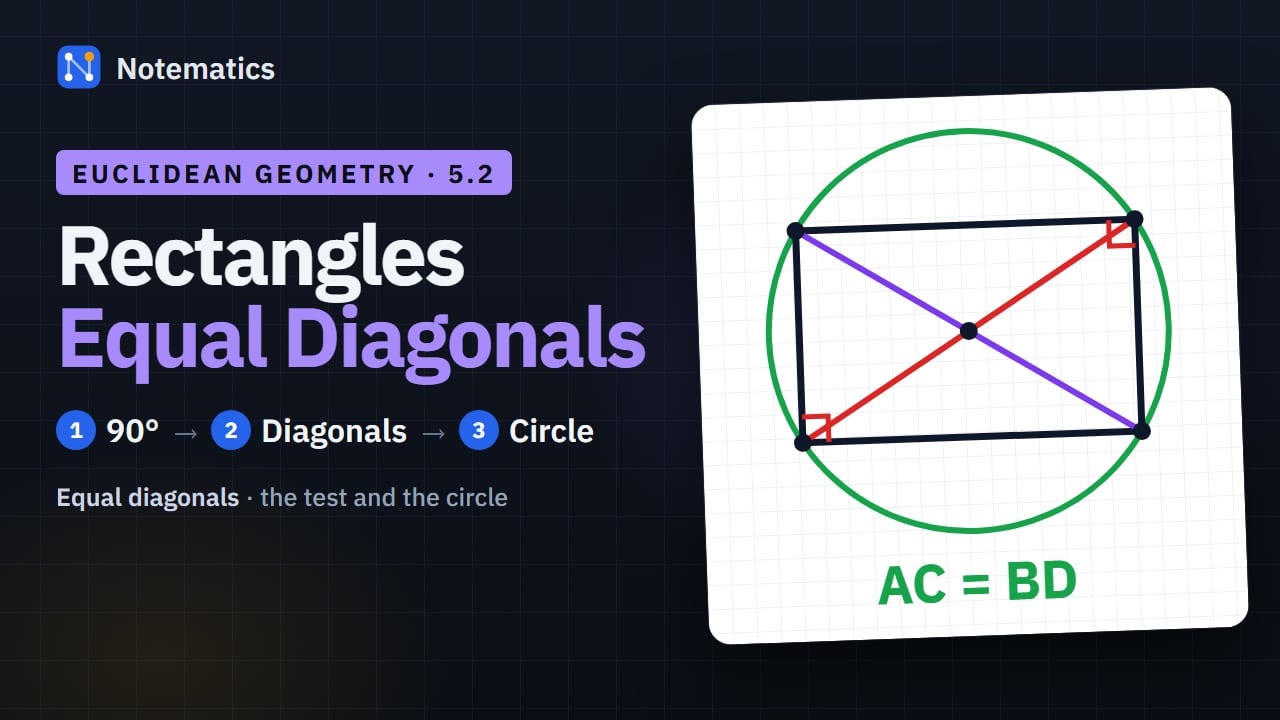
A rectangle is a parallelogram with a right angle, and that one right angle forces the other three. See why the diagonals of a rectangle are equal (a short proof with congruent triangles), why a parallelogram with equal diagonals must be a rectangle (the carpenter's test), and why a circle passes through all four vertices. Then a worked example with a 60° angle between the diagonals, and four practice questions with answers.
What the lesson covers
A parallelogram with a right angle; equal diagonals and the converse; the circle through the four vertices; an example.
- 8 pages
- 40 steps
- video 6:36
Watch
The board is kept in this browser only, like your other boards, and is yours to change. Each press makes a new board.
What to remember
- A rectangle is a parallelogram with a right angle. Then all four angles are right angles.
- It keeps every property of a parallelogram.
- Its diagonals are equal, and they bisect each other.
- A parallelogram with equal diagonals is a rectangle.
- A circle about the meeting point of the diagonals passes through all four vertices.
Pages and steps
- What is a rectangle
- The figure
- Definition
- Angle B
- Angles C and D
- Still a parallelogram
- Proof: the diagonals are equal
- Statement
- Two diagonals
- Line 1
- Line 2
- Line 3
- Line 4
- Line 5
- The test: equal diagonals
- Equal diagonals
- The claim
- Congruent triangles
- Equal angles
- Right angles
- Careful
- The circle through the vertices
- The center
- Diagonals
- Four equal halves
- The circle
- Why right angles
- Example: sides from the diagonals
- Task and figure
- Second diagonal
- Halves
- Triangle BOC
- Side BC
- Side AB
- Answer
- Remember
- Remember
- Inherits
- Diagonals
- The test
- The circle
- Practice
- Four tasks
- Answers
- Answer 1
- Answer 2
- Answer 3
- Answer 4