Course · Geometry
6.1 Area Formulas
Where do the area formulas come from? Start with a rectangle and its unit squares. Cut a triangle off a parallelogram and move it: a rectangle. Put two triangles together: a parallelogram. Two trapezoids: a parallelogram again. A rhombus: half of the rectangle around it. Every formula is seen in a picture before it is written. Then a worked example with two heights of one parallelogram, and four practice questions with answers.
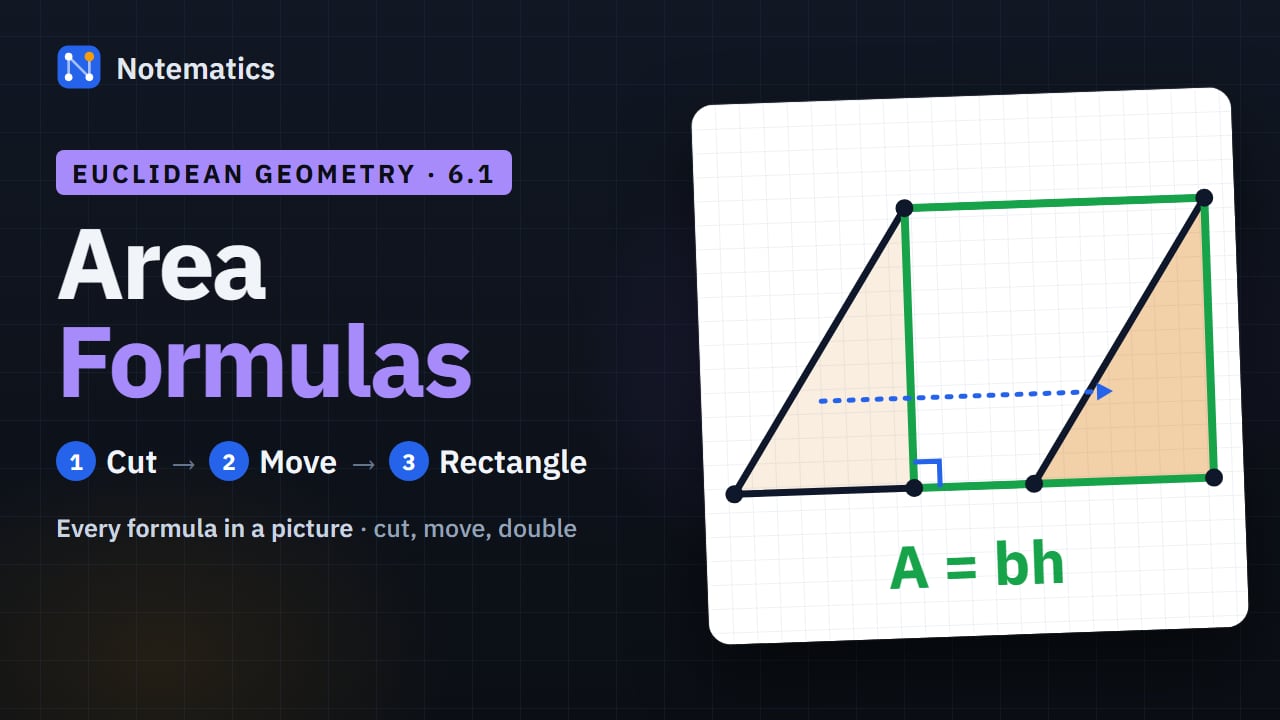
What the lesson covers
Perimeter and area; rectangle, parallelogram, triangle, trapezoid, rhombus: each formula from the one before, by cutting and moving.
- 8 pages
- 39 steps
- video 6:08
Watch
The board is kept in this browser only, like your other boards, and is yours to change. Each press makes a new board.
What to remember
- The perimeter is the length around a figure. The area is the surface inside it, in square units.
- Rectangle and parallelogram: A = bh. The height is perpendicular to the base.
- Triangle: A = ½·bh.
- Trapezoid: A = ½·(a + b)·h.
- Rhombus: A = ½·d₁·d₂.
Pages and steps
- Perimeter and area: the rectangle
- A rectangle
- Perimeter
- Area
- Unit squares
- Counting
- The formula
- Parallelogram: cut and move
- A parallelogram
- Height
- Cut
- Move
- A rectangle
- The formula
- Triangle: half of a parallelogram
- A triangle
- Height
- A second copy
- A parallelogram
- Half of it
- Any side
- Trapezoid and rhombus
- Trapezoid
- Two trapezoids
- Rhombus
- The rectangle around it
- One idea
- Example: two heights
- The parallelogram
- The given height
- The area
- The other height
- The same area
- Answer
- Remember
- Remember
- Rectangle, parallelogram
- Triangle
- Trapezoid
- Rhombus
- Practice
- Four tasks
- Answers
- Answer 1
- Answer 2
- Answer 3
- Answer 4