Course · Geometry
5.6 Regular Polygons
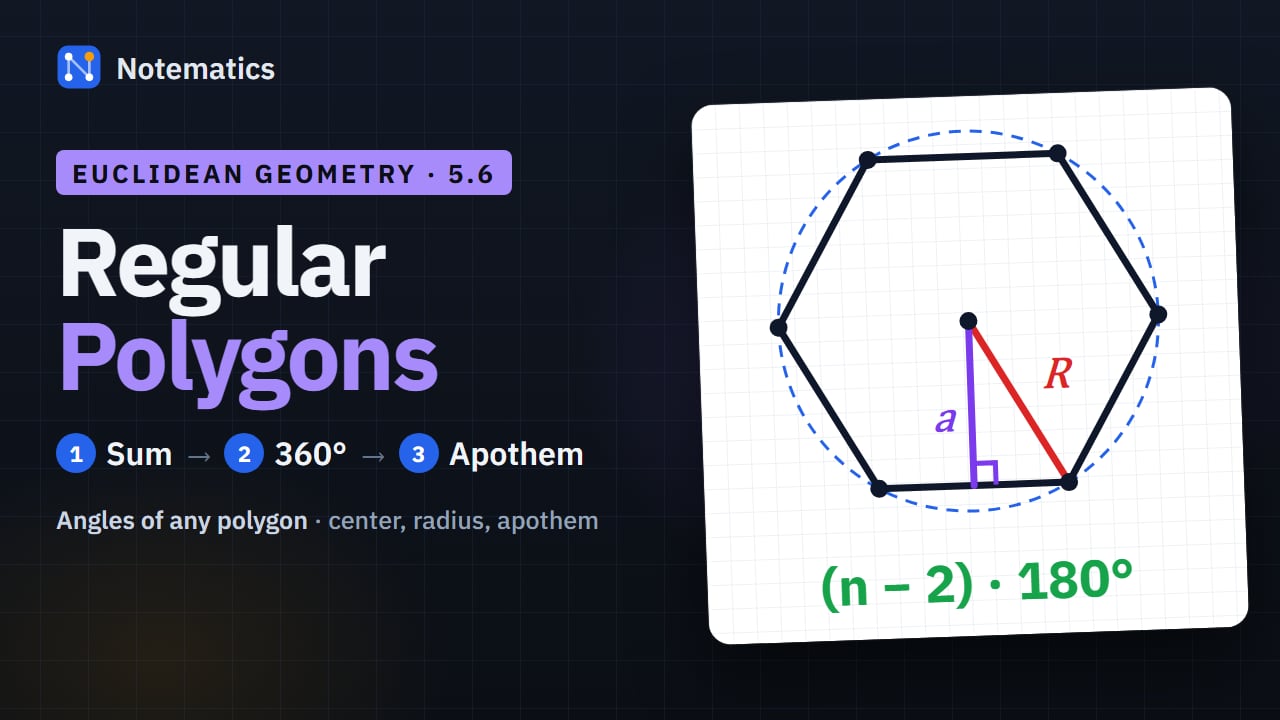
How many degrees are in a pentagon, a hexagon, any polygon? Cut it into triangles and count: the angles of an n-gon add to (n − 2)·180°. The exterior angles are even simpler: they always add to 360°, whatever n is. Then regular polygons: equal sides and equal angles, the formula for each angle, and the words center, radius, apothem and central angle. A worked example (each angle is 150°: how many sides?) and four practice questions with answers.
What the lesson covers
The angle sum (n − 2)·180°; exterior angles add to 360°; a regular polygon's angle, center, radius, apothem, central angle.
- 9 pages
- 43 steps
- video 6:55
Watch
The board is kept in this browser only, like your other boards, and is yours to change. Each press makes a new board.
What to remember
- The angles of a polygon with n sides add to (n − 2)·180°.
- The exterior angles, one at each vertex, add to 360°.
- Regular: all sides equal and all angles equal. Each angle is (n − 2)·180°/n, each exterior angle 360°/n.
- Radius: center to a vertex. Apothem: center to a side, perpendicular. Central angle: 360°/n.
Pages and steps
- Polygons
- Triangle
- Quadrilateral
- Pentagon
- Hexagon
- And so on
- The sum of the angles
- A pentagon
- Diagonals
- Three triangles
- Any polygon
- Some values
- Exterior angles
- The pentagon
- Five exterior angles
- Count
- Any polygon
- A walk
- Regular polygons
- Regular
- Triangle
- Square
- pentagon
- hexagon
- The formula
- Center, radius, apothem
- A hexagon
- Center
- Radius
- Central angle
- Apothem
- n triangles
- Example: how many sides
- One corner
- Exterior angle
- How many sides
- The polygon
- Central angle
- Check
- Answer
- Remember
- Remember
- Exterior
- Regular
- Inside
- Practice
- Four tasks
- Answers
- Answer 1
- Answer 2
- Answer 3
- Answer 4