Course · Geometry
6.3 Areas of Polygons
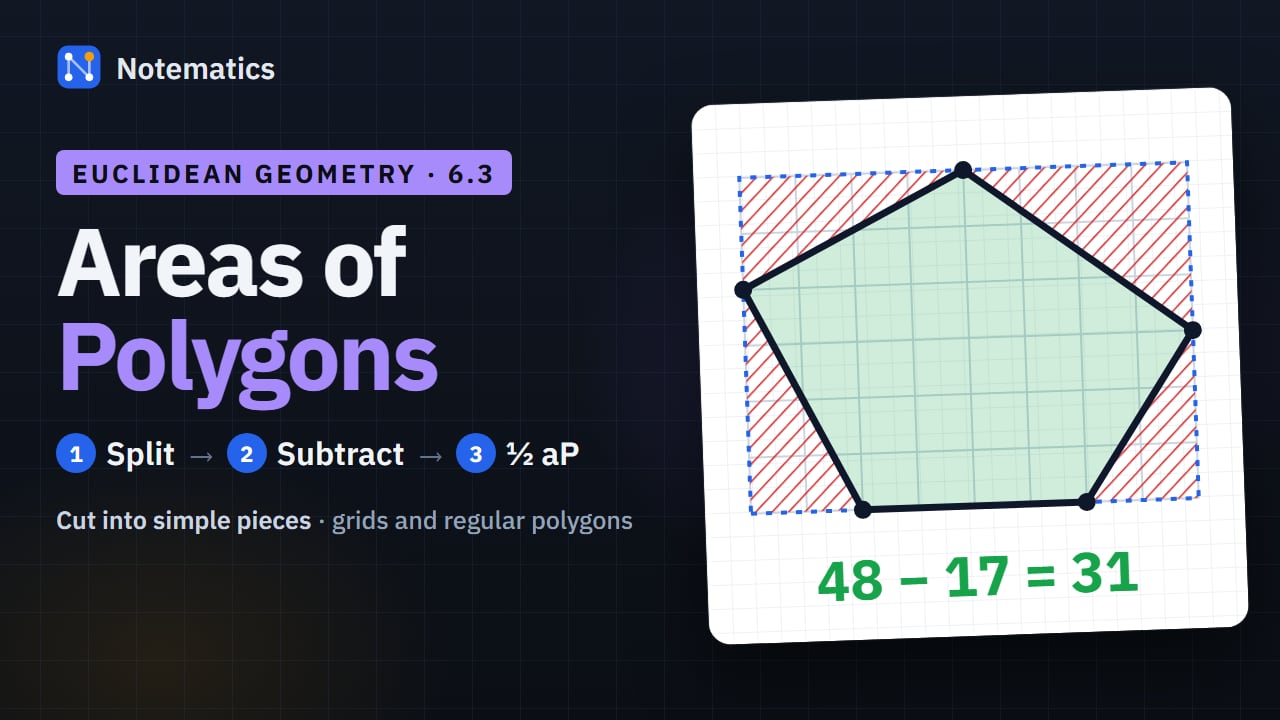
How to find the area of a figure that has no formula of its own. Two ideas do almost everything: split the figure into simple pieces and add, or take a big simple figure and subtract what is missing. See both on one L-shape, then on a pentagon drawn on a grid (the box minus its corners). Last, a regular polygon: n equal triangles around the center give A = ½ · apothem · perimeter, worked on a regular hexagon. Four practice questions with answers at the end.
What the lesson covers
Composite figures: split or subtract; a polygon on a grid; a regular polygon: half the apothem times the perimeter.
- 8 pages
- 38 steps
- video 5:53
Watch
The board is kept in this browser only, like your other boards, and is yours to change. Each press makes a new board.
What to remember
- Areas add up: split a figure into simple pieces and add their areas.
- Or subtract: a big simple figure minus what is missing.
- On a grid: the box around the polygon minus the corner triangles.
- Regular polygon: A = ½·a·P, with a the apothem and P the perimeter.
Pages and steps
- Split into simple pieces
- A figure with no formula
- Cut
- The first piece
- The second piece
- Add
- Another cut
- Or subtract
- The same figure
- The big rectangle
- What is missing
- Subtract
- The same answer
- Example 1: a polygon on a grid
- Task
- A box around it
- Four corners
- Add the corners
- Subtract
- Answer
- Regular polygons
- A regular hexagon
- Equal triangles
- One triangle
- Its area
- All n triangles
- The formula
- Example 2: a regular hexagon
- The hexagon
- An equilateral triangle
- The apothem
- The perimeter
- The area
- Answer
- Remember
- Remember
- Subtract
- On a grid
- Regular polygon
- Practice
- Four tasks
- Answers
- Answer 1
- Answer 2
- Answer 3
- Answer 4