Course · Geometry
6.4 Areas Involving Circles
Circles and area, from the beginning. What π is: unroll a circle and it holds its diameter three times and a little more. Why the area is πr²: cut the circle into slices, put them in a row, and a rectangle πr wide and r high appears. Then the parts of a circle (sector, segment, ring) and two worked examples: a sector and its segment, and a shaded region between a square and a circle. Four practice questions with answers at the end.
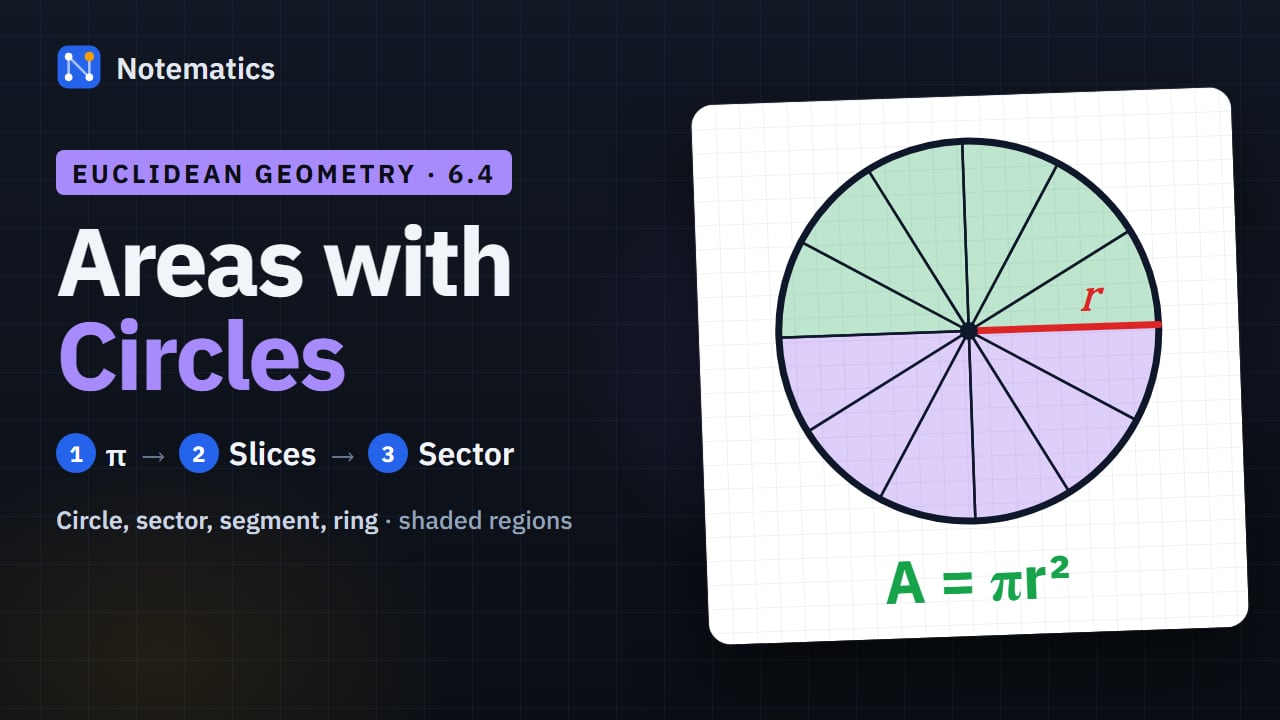
What the lesson covers
Circumference and π; the area πr² and why; sector, segment, ring; shaded regions.
- 8 pages
- 38 steps
- video 6:08
Watch
The board is kept in this browser only, like your other boards, and is yours to change. Each press makes a new board.
What to remember
- Circumference: C = 2πr = πd, with π ≈ 3.14.
- Area of a circle: A = πr².
- A sector with angle n°: A = (n/360)·πr².
- Segment = sector − triangle. Ring: A = π(R² − r²).
- Shaded regions: add and subtract simple areas.
Pages and steps
- Circumference and π
- A circle
- Diameter
- Unroll it
- Compare
- The number π
- The formula
- The area of a circle
- A circle
- Slices
- A row of slices
- Its sides
- Thinner slices
- The formula
- Sector, segment and ring
- Sector
- Segment
- Ring
- Two meanings
- Example 1: a sector and a segment
- The circle
- The sector
- The triangle
- Its area
- The segment
- Answer
- Example 2: a shaded region
- The figure
- The square
- The radius
- The circle
- Subtract
- Answer
- Remember
- Remember
- Area
- Sector
- Segment and ring
- Shaded regions
- Practice
- Four tasks
- Answers
- Answer 1
- Answer 2
- Answer 3
- Answer 4