Course · Geometry
7.1 Distance Formula
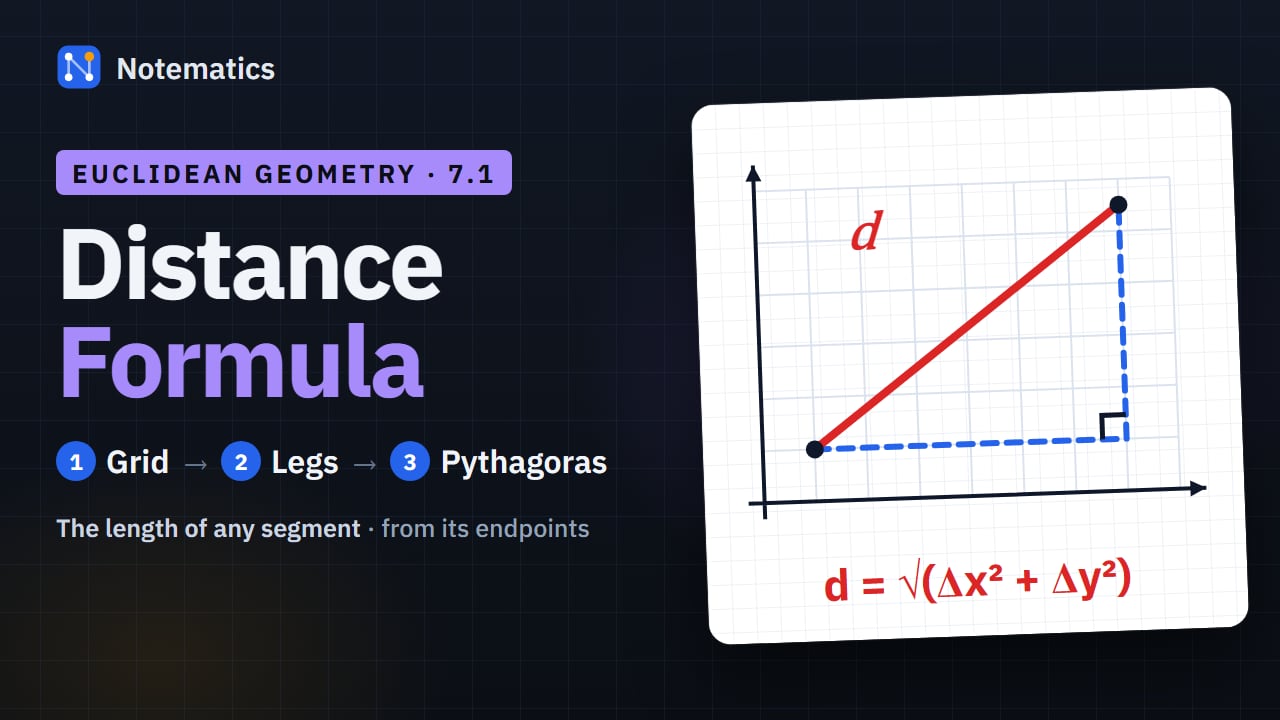
How to find the distance between two points on the coordinate plane, and why the formula works. Along the grid a distance is just a difference of coordinates. A slanted segment is the hypotenuse of a right triangle whose legs run along the grid, so the Pythagorean theorem gives its length: that is the whole distance formula. Two worked examples (one with a negative coordinate, one that asks whether a triangle is isosceles) and four practice questions with answers.
What the lesson covers
Distance on an axis; the formula from a right triangle; examples; is this triangle isosceles?
- 8 pages
- 37 steps
- video 5:50
Watch
The board is kept in this browser only, like your other boards, and is yours to change. Each press makes a new board.
What to remember
- Along the grid: subtract the coordinates that change and take the absolute value.
- For any two points: d = √((x₂ − x₁)² + (y₂ − y₁)²).
- The formula is the Pythagorean theorem: the legs are the change in x and the change in y.
- Mind the signs when a coordinate is negative: 4 − (−2) = 6.
Pages and steps
- Distance along the grid
- The grid
- A horizontal segment
- Its length
- A vertical segment
- Its length
- The rule
- A slanted segment
- Two legs
- The distance AB
- A right triangle
- The Pythagorean theorem
- The numbers
- The distance
- The distance formula
- Two points
- The legs
- The distance
- Pythagoras again
- The formula
- No absolute values
- Example 1: two points
- The points
- The formula
- The legs
- Compute
- Answer
- Example 2: is it isosceles?
- The triangle
- Side AB
- Side AC
- Side BC
- Answer
- Remember
- Remember
- The formula
- Where it comes from
- Signs
- Practice
- Four tasks
- Answers
- Answer 1
- Answer 2
- Answer 3
- Answer 4