Course · Geometry
8.1 Translations
The first lesson on transformations. A transformation takes a figure (the preimage) to a new figure (the image). The simplest one is a translation: every point slides the same distance in the same direction, along one vector. See the rule (x, y) → (x + a, y + b) on the coordinate plane, why the image is congruent to the preimage, two worked examples and four practice questions with answers.
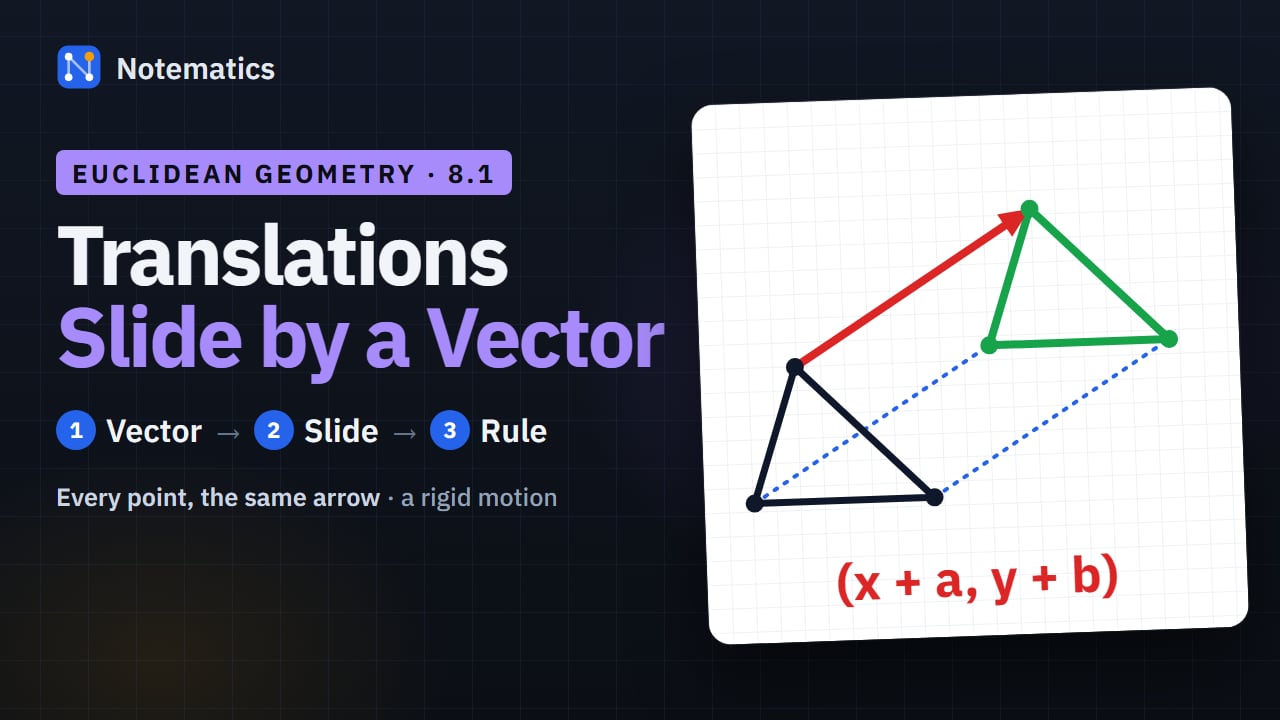
What the lesson covers
Image and preimage; a slide by a vector; the rule (x + a, y + b); what a translation keeps.
- 9 pages
- 40 steps
- video 6:55
Watch
The board is kept in this browser only, like your other boards, and is yours to change. Each press makes a new board.
What to remember
- A transformation takes a preimage to its image: A → A′.
- A translation slides every point by the same vector.
- By the vector ⟨a, b⟩: (x, y) → (x + a, y + b).
- A translation is a rigid motion: lengths and angles stay the same, and every side stays parallel to itself.
Pages and steps
- Transformations
- Preimage
- Image
- A prime
- A slide
- Only a slide
- The translation vector
- The vector
- A slides
- B and C slide
- The image
- Equal and parallel
- A parallelogram
- On the coordinate plane: the rule
- A triangle on the axes
- Count squares
- In numbers
- The other vertices
- The rule
- What a translation keeps
- Preimage and image
- Lengths
- Angles
- Congruent
- Parallel sides
- Example 1: translate a quadrilateral
- The quadrilateral
- The rule
- The vertex A
- B, C and D
- The image
- Example 2: find the vector
- Two points
- The vector
- The rule
- The point Q
- Answer
- Remember
- Remember
- A slide
- The rule
- Rigid
- Practice
- Four tasks
- Answers
- Answer 1
- Answer 2
- Answer 3
- Answer 4