Course · Geometry
8.2 Rotations
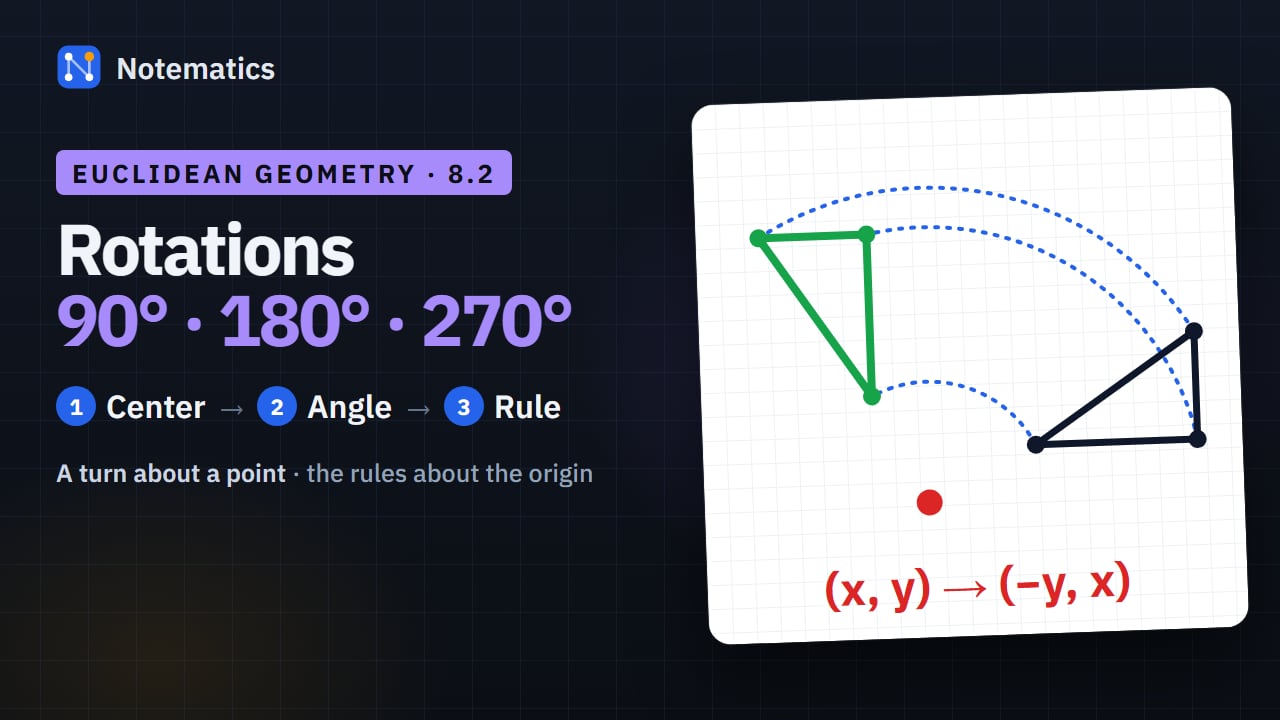
A rotation turns a figure about a fixed point, the center, through an angle. See what the center, the angle and the direction mean, how a whole figure is rotated vertex by vertex, and where the coordinate rules for 90°, 180° and 270° about the origin come from. Then a worked example and four practice questions with answers.
What the lesson covers
Center, angle, direction; the rules for 90°, 180°, 270° about the origin; what a rotation keeps.
- 9 pages
- 40 steps
- video 6:58
Watch
The board is kept in this browser only, like your other boards, and is yours to change. Each press makes a new board.
What to remember
- A rotation turns every point about the center through the same angle. Counterclockwise is positive.
- The center stays in place; every other point keeps its distance from it.
- About the origin: 90°: (x, y) → (−y, x); 180°: (x, y) → (−x, −y); 270°: (x, y) → (y, −x).
- A rotation is a rigid motion: the image is congruent to the preimage.
Pages and steps
- Rotation
- Center and point
- The turn
- The angle
- The same distance
- Three things
- Two directions
- Counterclockwise
- Clockwise
- When nothing is said
- The same turn
- Rotating a figure
- Triangle and center
- A turns
- B and C turn
- The image
- A rigid motion
- Turned sides
- 90° about the origin
- The point P
- A quarter turn
- The path turns too
- In numbers
- The rule
- One more point
- 180° and 270° about the origin
- 90°
- 180°
- 270°
- 360°
- Clockwise
- Example: two rotations
- The triangle
- The rule for 90°
- The first image
- By 180°
- Answer
- Remember
- Remember
- The center
- The rules
- Rigid
- Practice
- Four tasks
- Answers
- Answer 1
- Answer 2
- Answer 3
- Answer 4