Course · Geometry
8.4 Dilations
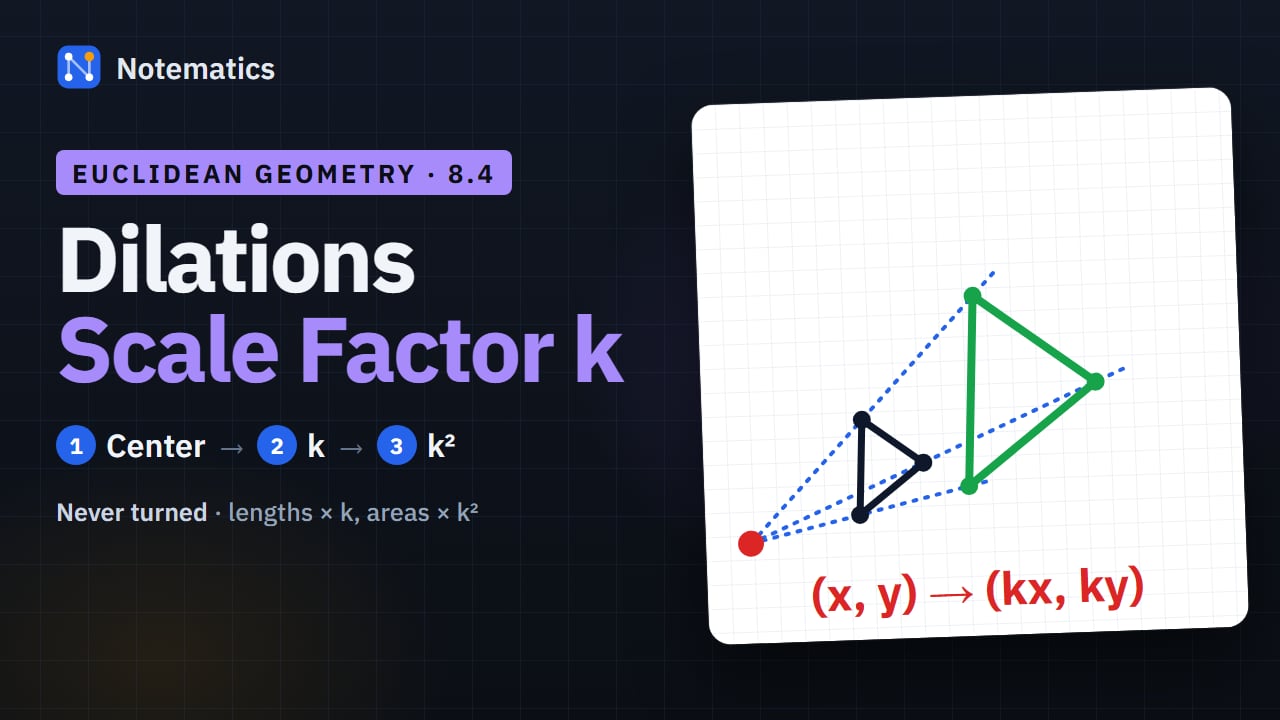
A dilation enlarges or reduces a figure from a fixed center by a scale factor k. See how every point moves along its ray from the center, when the image is larger and when it is smaller, the coordinate rule (x, y) → (kx, ky), and why lengths are multiplied by k but areas by k². The image is similar to the preimage. Then two worked examples and four practice questions with answers.
What the lesson covers
Center and scale factor; the rule (kx, ky); enlargement, reduction; lengths times k, areas times k²; similar figures.
- 9 pages
- 40 steps
- video 6:23
Watch
The board is kept in this browser only, like your other boards, and is yours to change. Each press makes a new board.
What to remember
- A dilation has a center O and a scale factor k: P′ lies on the ray OP, and OP′ = k · OP.
- k > 1 enlarges. 0 < k < 1 reduces.
- About the origin: (x, y) → (kx, ky).
- Lengths are multiplied by k, areas by k². Angles stay the same: the image is similar to the preimage.
- A dilation is not a rigid motion, unless k = 1.
Pages and steps
- Dilation
- Center and triangle
- A moves
- B and C move
- The image
- Center and scale factor
- Here k = 2
- Enlargement or reduction
- Enlargement
- Reduction
- Never turned
- Dilation about the origin
- A triangle on the axes
- The vertex A
- B and C
- The image
- The rule
- What a dilation changes and keeps
- A right triangle
- Dilate with k = 2
- Lengths
- Angles
- Areas
- Four copies
- The fact
- Example 1: a reduction
- The triangle
- The rule
- The image
- The areas
- Answer
- Example 2: find the scale factor
- Two points
- The scale factor
- The point Q
- Answer
- Remember
- Remember
- Larger or smaller
- The rule
- Lengths, areas, angles
- Not rigid
- Practice
- Four tasks
- Answers
- Answer 1
- Answer 2
- Answer 3
- Answer 4