Course · Geometry
8.5 Symmetry
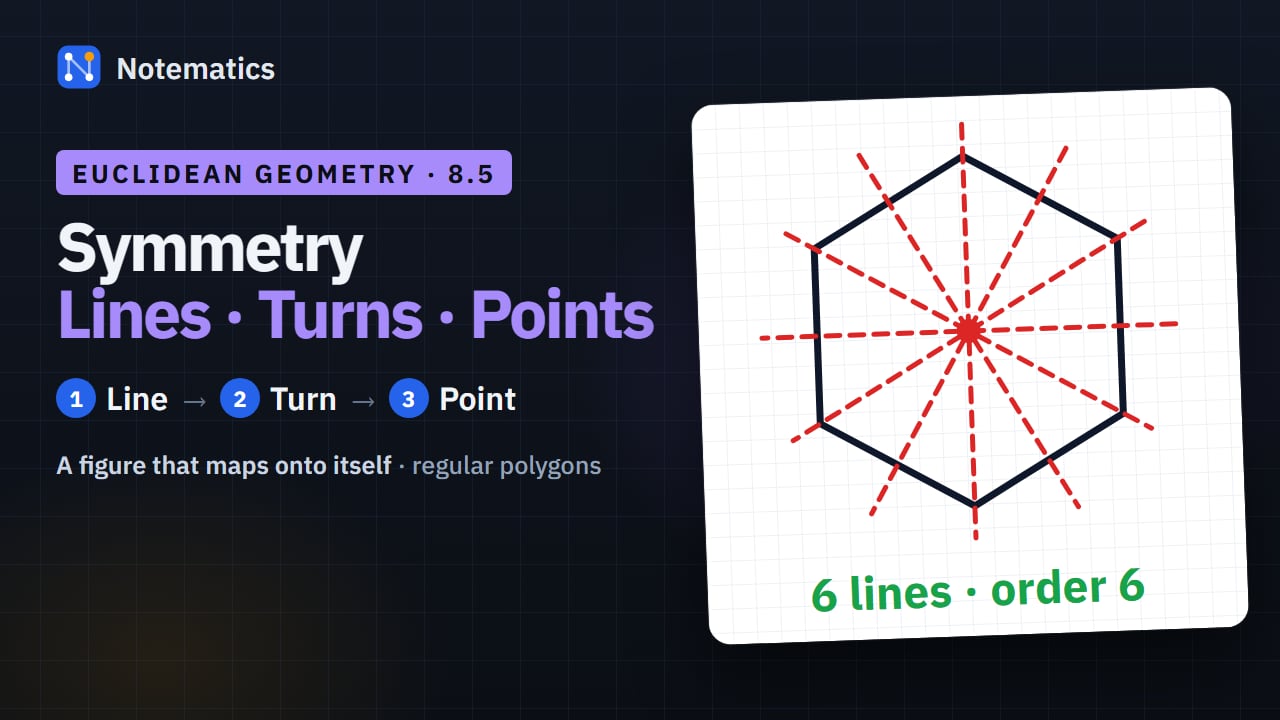
A figure is symmetric when a transformation maps it onto itself. A reflection gives line symmetry, a turn gives rotational symmetry, and a half turn gives point symmetry. See how to find the lines of symmetry of a figure, what the order of rotational symmetry is, why a parallelogram has point symmetry but no line of symmetry, and all the symmetries of regular polygons. Then a worked example (a rhombus, an isosceles trapezoid, a pinwheel) and four practice questions with answers.
What the lesson covers
Line symmetry; rotational symmetry and its order; point symmetry; the symmetries of regular polygons.
- 9 pages
- 41 steps
- video 6:29
Watch
The board is kept in this browser only, like your other boards, and is yours to change. Each press makes a new board.
What to remember
- Line symmetry: a reflection maps the figure onto itself.
- Rotational symmetry of order n: a turn of 360°/n maps the figure onto itself.
- Point symmetry is a half turn: rotational symmetry of order 2.
- A regular polygon with n sides has n lines of symmetry and rotational symmetry of order n.
Pages and steps
- Line symmetry
- A figure
- The line
- Mirror pairs
- Two halves
- Line of symmetry
- How many lines of symmetry?
- Isosceles triangle
- Rectangle
- Equilateral triangle
- Parallelogram
- Not the diagonal
- Rotational symmetry
- An equilateral triangle
- The angle
- A turn of 120°
- The order
- The smallest turn
- Order 1
- Point symmetry
- A parallelogram
- Its center
- Partners
- Center of symmetry
- Not the same thing
- Letters
- Symmetries of regular polygons
- Triangle
- Square
- Pentagon
- Hexagon
- Where the lines go
- Point symmetry
- Example: three figures
- Three figures
- The rhombus
- The trapezoid
- The pinwheel
- Remember
- Remember
- Rotational symmetry
- Point symmetry
- Regular polygons
- Practice
- Four tasks
- Answers
- Answer 1
- Answer 2
- Answer 3
- Answer 4