Course · Geometry
9.1 Pythagorean Theorem
The most famous theorem of geometry: in a right triangle, a² + b² = c². See what it says with three squares, why it is true (four triangles moved inside a square: a proof you can see), and how to use it to find a hypotenuse or a leg. Then the Pythagorean triples worth knowing by heart and the converse, which tests whether a triangle has a right angle. Four practice questions with answers at the end.
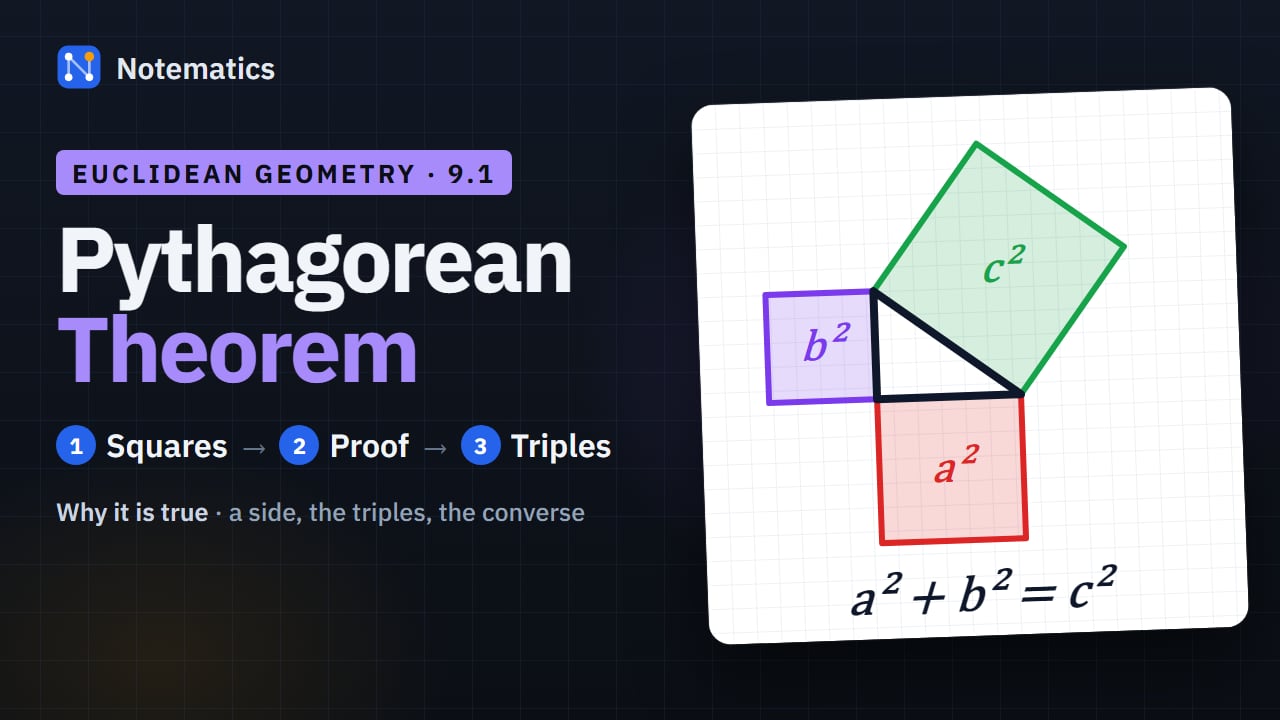
What the lesson covers
Legs and hypotenuse; the theorem with a proof by rearranging; finding a side; triples; the converse.
- 9 pages
- 38 steps
- video 6:25
Watch
The board is kept in this browser only, like your other boards, and is yours to change. Each press makes a new board.
What to remember
- In a right triangle a² + b² = c², where c is the hypotenuse: the side opposite the right angle.
- Hypotenuse: c = √(a² + b²). A leg: a = √(c² − b²).
- Triples to know: 3, 4, 5; 5, 12, 13; 8, 15, 17; and their multiples.
- The converse: if a² + b² = c², the triangle has a right angle opposite c.
Pages and steps
- The Pythagorean theorem
- Right triangle
- Legs
- Hypotenuse
- Square on a
- Square on b
- Square on c
- The theorem
- Why it is true
- First way
- What is left
- Second way
- What is left
- Equal
- Example 1: the hypotenuse
- Triangle
- The theorem
- Squares
- Root
- Example 2: a leg
- Picture
- The theorem
- Subtract
- Root
- Pythagorean triples
- 3, 4, 5
- 5, 12, 13
- 8, 15, 17
- Multiples
- The converse
- The converse
- A triangle
- Two shorter sides
- Longest side
- Yes
- Remember
- Remember
- Finding a side
- Triples
- Converse
- Practice
- Four tasks
- Answers
- Answer 1
- Answer 2
- Answer 3
- Answer 4