Course · Geometry
5.3 Rhombi
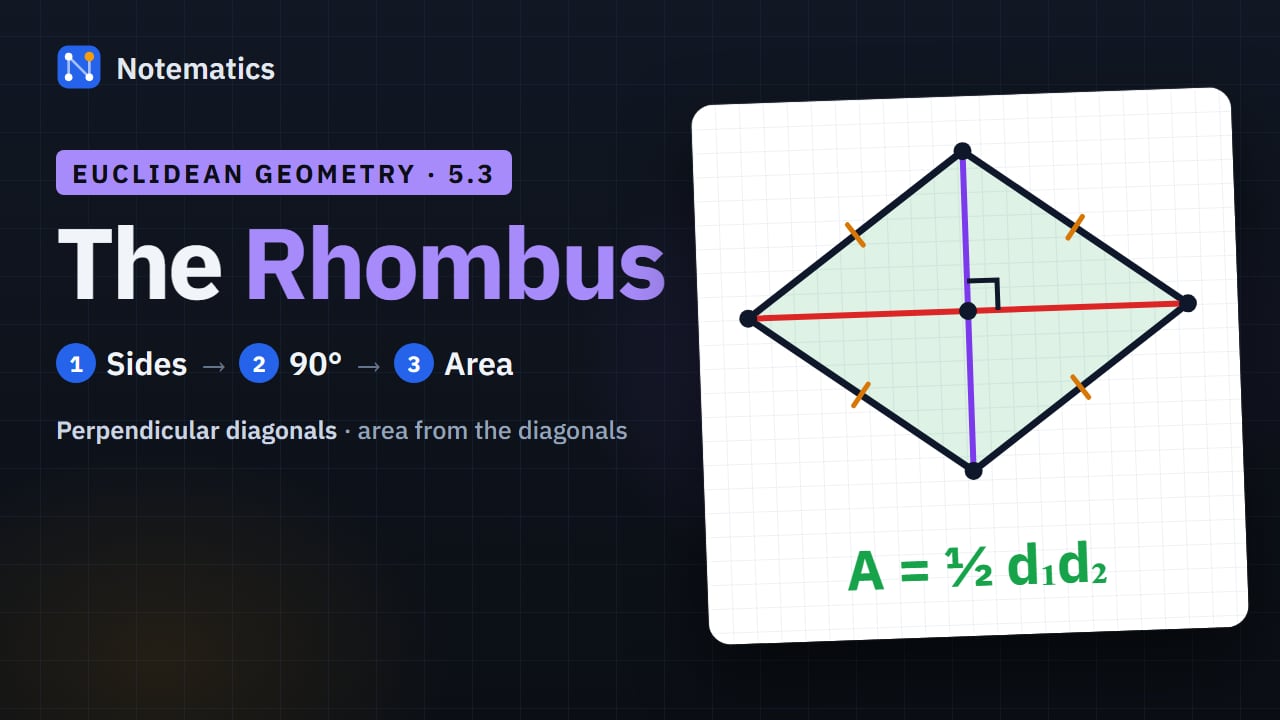
A rhombus is a parallelogram with four equal sides. That is enough to make its diagonals special: they are perpendicular, and each of them bisects two angles of the rhombus. See the proof with congruent triangles, then how the diagonals cut the rhombus into four equal right triangles and why its area is half the product of the diagonals. A worked example (diagonals 24 and 10) and four practice questions with answers.
What the lesson covers
A parallelogram with equal sides; diagonals perpendicular, bisecting the angles; area from the diagonals; an example.
- 8 pages
- 39 steps
- video 5:52
Watch
The board is kept in this browser only, like your other boards, and is yours to change. Each press makes a new board.
What to remember
- A rhombus is a parallelogram with four equal sides.
- Its diagonals are perpendicular.
- Each diagonal bisects two angles of the rhombus.
- The diagonals cut it into four congruent right triangles.
- Area: half the product of the diagonals, A = ½ · d₁ · d₂.
Pages and steps
- What is a rhombus
- The figure
- Definition
- Equal sides
- Still a parallelogram
- Proof: the diagonals are perpendicular
- Statement
- Two diagonals
- Line 1
- Line 2
- Line 3
- Line 4
- Line 5
- The diagonals bisect the angles
- Figure
- AC bisects
- BD bisects
- The theorem
- Four triangles
- Area from the diagonals
- Area
- Diagonals
- A rectangle around
- Half of it
- The formula
- With numbers
- Example: side, perimeter, area
- Task and figure
- Halves
- A right triangle
- The side
- Perimeter
- Area
- Answer
- Remember
- Remember
- Perpendicular
- Bisect the angles
- Four triangles
- Area
- Practice
- Four tasks
- Answers
- Answer 1
- Answer 2
- Answer 3
- Answer 4