Course · Geometry
5.4 Squares
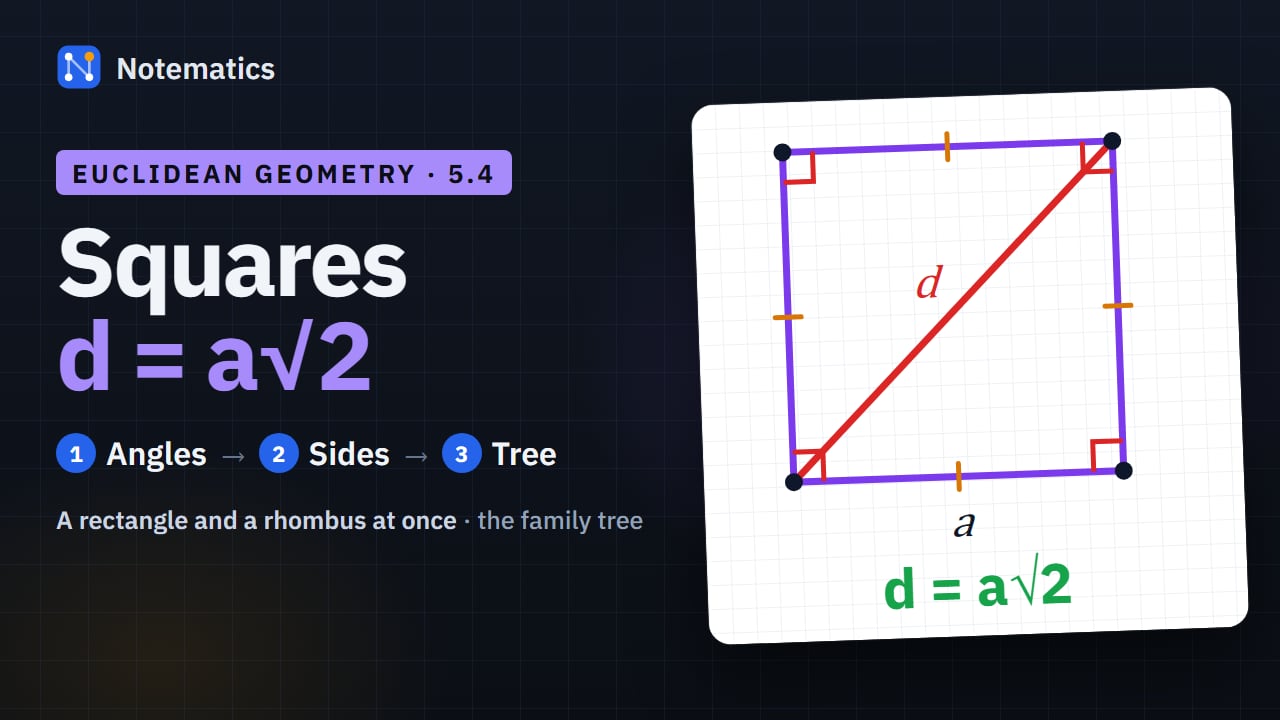
A square is a rectangle and a rhombus at the same time, so it inherits everything: right angles and equal diagonals from the rectangle, equal sides and perpendicular diagonals from the rhombus, diagonals that bisect each other from the parallelogram. See where the formula d = a√2 for the diagonal comes from, and how the family tree of quadrilaterals fits together: quadrilateral, trapezoid, parallelogram, rectangle, rhombus, square. Then a worked example and four practice questions with answers.
What the lesson covers
A rectangle and a rhombus at once; its diagonal; the family tree of quadrilaterals.
- 8 pages
- 34 steps
- video 5:38
Watch
The board is kept in this browser only, like your other boards, and is yours to change. Each press makes a new board.
What to remember
- A square is a rectangle and a rhombus at once: four right angles and four equal sides.
- Its diagonals are equal, perpendicular, and bisect each other and the angles (45°).
- The diagonal of a square with side a is d = a√2.
- Every square is a rectangle, a rhombus and a parallelogram. Not every rectangle or rhombus is a square.
Pages and steps
- What is a square
- The figure
- Right angles
- Equal sides
- Definition
- Three sets of properties
- Parallelogram
- Rectangle
- Rhombus
- All three
- The diagonal of a square
- The side
- The diagonal
- Pythagoras
- The formula
- Back to the side
- The family tree of quadrilaterals
- Quadrilateral
- Two branches
- Rectangle
- Rhombus
- Square
- How to read it
- Example: from the diagonal
- Task and figure
- The formula
- The side
- Perimeter
- The center
- Answer
- Remember
- Remember
- Diagonals
- Formula
- Family
- Practice
- Four tasks
- Answers
- Answer 1
- Answer 2
- Answer 3
- Answer 4