Course · Geometry
5.5 Trapezoids
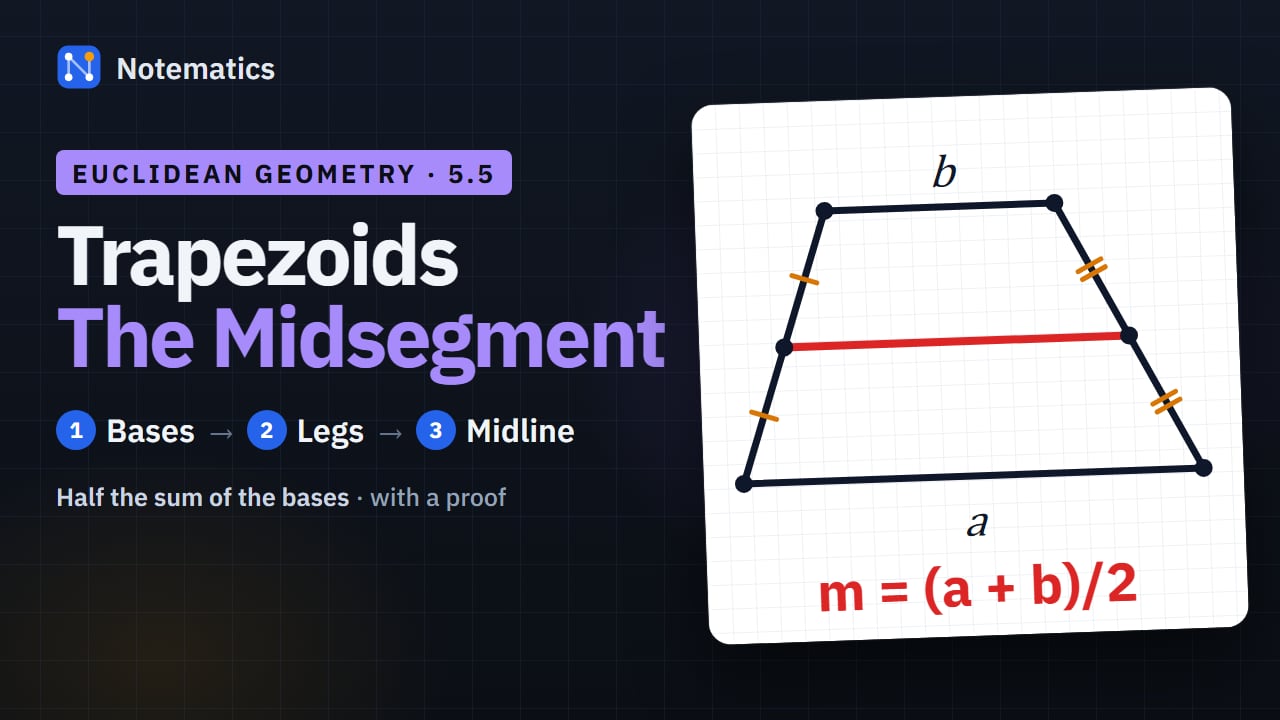
A trapezoid is a quadrilateral with exactly one pair of parallel sides. Meet its bases, legs and height, the three kinds (scalene, isosceles, right), and the special properties of the isosceles trapezoid: equal base angles and equal diagonals. Then the midsegment theorem, with a proof: the segment joining the midpoints of the legs is parallel to the bases and equal to half their sum. A worked example (bases 16 and 6, legs 13) and four practice questions with answers.
What the lesson covers
Bases and legs; isosceles and right trapezoids; the midsegment is half the sum of the bases; an example.
- 9 pages
- 42 steps
- video 7:11
Watch
The board is kept in this browser only, like your other boards, and is yours to change. Each press makes a new board.
What to remember
- A trapezoid has exactly one pair of parallel sides: the bases. The other two sides are the legs.
- The two angles on the same leg add to 180°.
- Isosceles trapezoid: equal legs, equal angles at each base, equal diagonals.
- Right trapezoid: one leg is perpendicular to the bases.
- The midsegment joins the midpoints of the legs. It is parallel to the bases, and m = (a + b)/2.
Pages and steps
- What is a trapezoid
- The figure
- Bases
- Legs
- Definition
- Height
- Three kinds of trapezoids
- Scalene
- Isosceles
- Right
- Angles on a leg
- The isosceles trapezoid
- Equal legs
- Base angles
- Why
- Diagonals
- The theorem
- The midsegment
- Two bases
- Midpoints
- The midsegment
- The theorem
- With numbers
- Proof of the midsegment theorem
- Statement
- Line 1
- Line 2
- Line 3
- Line 4
- Line 5
- Example: midsegment, height, perimeter
- Task and figure
- Midsegment
- Two heights
- The piece AH
- Height
- Perimeter
- Answer
- Remember
- Remember
- Angles on a leg
- Isosceles
- Right
- Midsegment
- Practice
- Four tasks
- Answers
- Answer 1
- Answer 2
- Answer 3
- Answer 4